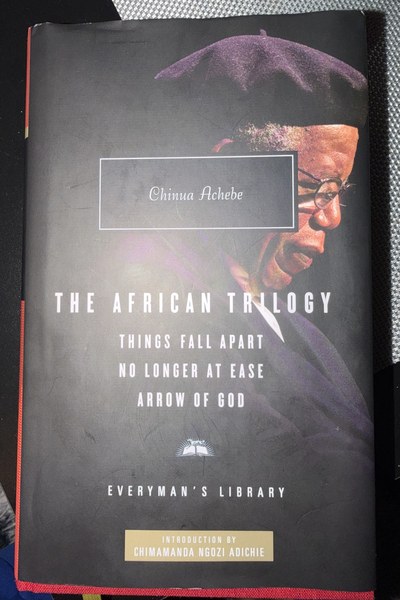
Its a simple story set in Africa about a time when old times were being replaced by new times. Endearing old times derived from nature were replaced by rigid customs named after humans. Stories are the same in human history, but it’s the voice and narration that distinguishes memorable stories from the mediocre ones. Achebe’s narration about simple times facing changes belongs to the memorable stories category and his motivation is derived from Yeats’ The Second Coming.
Achebe’s simplicity is endearing and so is his grammar where he seamlessly blends local/tribal lingo with polished English. The otherwise alien words mix so well together that no dictionary or search is needed to understand the local words. Achebe’s pride in his roots is evident in the story as he balances the struggles of family life, social life and modern times in Okonkwo’s character.
The story paces the slowness of simple times and nothing dramatic ever happens but we still feel the village setting, the clan politics and gain an insight into human emotions through Okonkwo’s relationship with everyone else - his father, his wives, his children, elders of the village, and his own ego.
A man of few words expresses his emotions through his actions - repentance on fleeing the village after an accidental gun shot kills a village youth, team player by abandoning his eldest son when the latter converts, strategic mind by asking his daughter to delay her marriage proposals till they return to his paternal village, learning as he understands the maternal side of culture from his uncle, caring as he tracks his favourite wife to the cave without her knowing, and above all hubris/ego/pride in his final actions.
Achebe’s strength is showing how simplicity without force can thrive too. He portrays the simple clan people understanding, thoughtful and having foresight into changes. Achebe’s novelty is in depicting the clan as humans and not savages, depicting the simplicity of tribal life as a functioning society with its own hierarchy and practices. Using nature as the background and tenderly explains its rules/patterns through the repetition of yam harvests and moon cycles - simple world with simple customs and rules to respect.
Missionaries arrival did worry them - there were omens from the elders, but they desired to live in harmony together. It was an unfortunate action that led to the blending of two times with blood and lives lost. The egoism and superior belief of the missionary in his own God that pushed the conflict over the edge. While Brown was understanding and wanted to assimilate with the local customs, Smith tried to boss around with his superiority complex.
In the end, Okonkwo’s friend tells us more about the clan’s customs, while Achebe sarcastically closes the book on the intellectual hubris of the officer who reads and writes - will shrink Okonkwo’s memory to a paragraph in a book - but failed to understand and adapt to the Igbo clan.
This book was on my reading list for a long time, and I received it as a gift last week. I enjoyed the simple, short story with such depth of human emotions carefully weaved together in the fictional Igbo clan of Umuofia.
Tender storytelling that leaves an impression because its style contrasts the force of Yeats’ The Second Coming that also warns the end of simpler times. Yeats’ personal feeling and experience are loud, but Achebe’s use of the Igbo clan, its customs and people to soften Yeats’ loud voice as Things Fell Apart in the Igbo’s past.
I find this quote from the book appropriate because we will long be gone, and with us our customs of living will depart to or get replaced, but Nnadi will still be here cooking and eating us all.
‘The rain is falling, the sun is shining,
Alone Nnadi is cooking and eating.’
- Chinua Achebe, Things Fall Apart
❓ Do you think this review was created by AI or humans?
Do you want to see how it came to its final form in discussion with AI?
📝 Original Draft
Its a simple story set in Africa about a time when old times were being replaced by new times. Endearing old times derived from nature were replaced by rigid customs named after humans. Stories are the same in human history, but it’s the voice and narration that distinguishes memorable stories from the mediocre ones. Achebe’s narration about simple times facing changes belongs to the memorable stories category. Simplicity is endearing and so is Achebe’s grammar where he seamlessly blend local/tribal lingo with polished English. The otherwise alien words mix so well together that no dictionary or search is needed to understand the local words. Achebe’s pride in his roots is evident in the story as he balances the sniffles of family life, social life and modern times in Okonkwo’s character.
The story paces the slowness of simple times and nothing dramatic ever happens but we still feel the village setting, the clan politics and the gan an insight of human emotions through Okonkwo’s relationship with everyone else - his father, his wives, his children, elders of the village, and his own ego.
A man of few words expresses his emotions through his actions - repentance on fleeing the village after an accidental gun shot kills a village youth, team player by abandoning his eldest son when the latter converts, strategic mind by asking his daughter to delay her marriage proposals till they return to his paternal village, learning as he understands the maternal side of culture from his uncle, caring as he tracks his favourite wife to the cave without her knowing, and above all hubris/ego/pride in his final actions.
Achebe’s strength is showing how simplicity without force can thrive too. He portrays the simple clan people understanding, thoughtful and having foresight into changes. Achebe’s novelty is in depicting the clan as humans and not savages, depicting the simplicity of tribal life as a functioning society with its own hierarchy and practices. Using nature as the background and tenderly explains its rules/patterns through the repetition of yam harvests and moon cycles - simple world with simple customs and rules to respect.
Missionaries arrival did not worry them, and they desired to live in harmony together. It was an unfortunate action that led to the blending of two times with blood and lives lost. The egoism and superior belief of the missionary in his own God that pushed the conflict over the edge.
In the end, Okonkwo’s friend tells us more about the clans customs, while Achebe sarcastically closes the book on the intellectual hubris of the officer who reads and writes but fails to understand and adapt.
This book was on my reading list for a long time, and I received it as a gift last week. I enjoyed the simple, short story with such depth of human emotions carefully weaved together in the fictional Igbo clan of Umuofia. Tender storytelling that leaves an impression.
🤖 AI Feedback 1
here is my review - version 1 - for the book Things fall apart - . Let me know what you think and grade it, and give me your feedback and criticism
Grade: B
This is a warm, readable, and largely accurate appreciation of Things Fall Apart. It's not yet a strong critical review, and the reason is instructive: almost everything you say about the book is true, but very little of it is yours in the sense of being an argument only you could have made. It reads like a well-written summary of the consensus view with a personal framing attached.
What works:
The line "Simplicity is endearing and so is Achebe's grammar where he seamlessly blend local/tribal lingo with polished English" is the best sentence in the piece. It identifies something specific about Achebe's craft—the seamlessness of the fusion, the fact that no dictionary is needed—and it does so without overexplaining. That's a genuine observation.
"It paces the slowness of simple times and nothing dramatic ever happens" is also good. It's counterintuitive (a novel where nothing dramatic happens and it still works), and it gestures at why the novel's structure is doing something deliberate. You could have built the whole review on that insight.
The catalogue of how Okonkwo expresses emotion through action—repentance, abandonment of his son, the cave tracking, the final hubris—is an efficient way to show character without quoting. It demonstrates you read closely.
What doesn't work as criticism:
The review never names what the book is about in a way that distinguishes it from any other colonial-era novel. "Old times replaced by new times" is true of every book in this genre. What makes Things Fall Apart singular is that Achebe wrote it as a response—to Conrad, to the colonial library, to the "savage" depiction of Africa that preceded it. You gesture at this ("depicting the clan as humans and not savages") but you don't name the target. A reader who doesn't already know the literary history won't understand why this book mattered.
The missionary section is the weakest part. "Missionaries arrival did not worry them, and they desired to live in harmony together. It was an unfortunate action that led to the blending of two times with blood and lives lost." This is not quite right, and it softens the novel's actual argument. The missionaries did worry them—that's why the clan debates what to do about them. And the conflict isn't caused by "an unfortunate action" plus the missionary's ego; it's caused by the structural collision of two systems of belief, one of which cannot tolerate the other's gods. Achebe is careful about this. Your summary makes it sound like a misunderstanding between reasonable people.
"The egoism and superior belief of the missionary in his own God that pushed the conflict over the edge" is a real theme, but it's stated as conclusion rather than shown. Which missionary? Which scene? The novel gives you Reverend Smith and Mr. Brown as a deliberate contrast—one who tries to understand, one who doesn't. You collapse them into one figure and lose the nuance.
The closing paragraph—"This book was on my reading list for a long time, and I received it as a gift last week"—is pleasant but not criticism. It tells us about your reading life, not about the book.
What's missing:
You never quote Achebe. Not one line. For a review of a novel whose power is largely in its prose, that's a significant omission. A single quoted passage—the locusts, the wrestling match, Okonkwo's fear of weakness—would anchor your claims about his style in something the reader can see.
You never mention the title's source (Yeats's "The Second Coming") or what it signals about Achebe's view of history. That's a critical absence, because the title is an argument: things don't just change, they fall apart. The center cannot hold. Your review describes change; the novel describes collapse.
You never address the ending's most famous move—the District Commissioner's decision to write a book called The Pacification of the Primitive Tribes of the Lower Niger, and his reduction of Okonkwo's entire life to a paragraph. You mention "Achebe sarcastically closes the book on the intellectual hubris of the officer" but you don't unpack it. That's the novel's final gesture, and it's doing something devastating: it shows that the colonial gaze will survive Okonkwo, will narrate him, will shrink him. The irony is that Achebe has just spent an entire novel doing the opposite. That's the payoff. Your review skips it.
What would push it to B+ or A-:
Name the literary target. Achebe wasn't writing in a vacuum; he was writing against a tradition. Say so.
Quote one passage. Even six words.
Pick one theme and argue it rather than listing all of them. The father-son thread (Unoka to Okonkwo to Nwoye to Isaac) is the richest and most structurally elegant. You gesture at it ("abandoning his eldest son when the latter converts") but you don't develop it. That thread contains the novel's whole argument about inheritance, masculinity, and change.
Fix the missionary paragraph. Distinguish Brown from Smith. Show the structural collision rather than the personal failing.
The honest summary:
This is a sincere, well-paced appreciation written by someone who read the book carefully and felt it. That's not nothing—most reviews are written by people who didn't. But it's a review that stays on the surface of a novel that rewards depth. You describe the book's qualities without interrogating them. You tell us what happens and how it feels. You don't tell us what it means or why it was necessary.
It's a B because the prose is clean, the observations are true, and the reading is honest. It's not higher because a B+ review of Things Fall Apart has to reckon with why this book, of all books, is the one that gets taught, translated, and argued over sixty years later. Your review could have been written about any good novel set in a changing society. It doesn't yet explain why it had to be this one.
📝 Revised Draft 1
Its a simple story set in Africa about a time when old times were being replaced by new times. Endearing old times derived from nature were replaced by rigid customs named after humans. Stories are the same in human history, but it’s the voice and narration that distinguishes memorable stories from the mediocre ones. Achebe’s narration about simple times facing changes belongs to the memorable stories category and his motivation is derived from Yeats’ The Second Coming.
Achebe’s simplicity is endearing and so is his grammar where he seamlessly blends local/tribal lingo with polished English. The otherwise alien words mix so well together that no dictionary or search is needed to understand the local words. Achebe’s pride in his roots is evident in the story as he balances the struggles of family life, social life and modern times in Okonkwo’s character.
The story paces the slowness of simple times and nothing dramatic ever happens but we still feel the village setting, the clan politics and gain an insight into human emotions through Okonkwo’s relationship with everyone else - his father, his wives, his children, elders of the village, and his own ego.
A man of few words expresses his emotions through his actions - repentance on fleeing the village after an accidental gun shot kills a village youth, team player by abandoning his eldest son when the latter converts, strategic mind by asking his daughter to delay her marriage proposals till they return to his paternal village, learning as he understands the maternal side of culture from his uncle, caring as he tracks his favourite wife to the cave without her knowing, and above all hubris/ego/pride in his final actions.
Achebe’s strength is showing how simplicity without force can thrive too. He portrays the simple clan people understanding, thoughtful and having foresight into changes. Achebe’s novelty is in depicting the clan as humans and not savages, depicting the simplicity of tribal life as a functioning society with its own hierarchy and practices. Using nature as the background and tenderly explains its rules/patterns through the repetition of yam harvests and moon cycles - simple world with simple customs and rules to respect.
Missionaries arrival did worry them - there were omens from the elders, but they desired to live in harmony together. It was an unfortunate action that led to the blending of two times with blood and lives lost. The egoism and superior belief of the missionary in his own God that pushed the conflict over the edge. While Brown was understanding and wanted to assimilate with the local customs, Smith tried to boss around with his superiority complex.
In the end, Okonkwo’s friend tells us more about the clan’s customs, while Achebe sarcastically closes the book on the intellectual hubris of the officer who reads and writes - will shrink Okonkwo’s memory to a paragraph in a book - but failed to understand and adapt to the Igbo clan.
This book was on my reading list for a long time, and I received it as a gift last week. I enjoyed the simple, short story with such depth of human emotions carefully weaved together in the fictional Igbo clan of Umuofia.
Tender storytelling that leaves an impression because its style contrasts the force of Yeats’ The Second Coming that also warns the end of simpler times. Yeats’ personal feeling and experience are loud, but Achebe’s use of the Igbo clan, its customs and people to soften Yeats’ loud voice as Things Fell Apart in the Igbo’s past.
🤖 AI Feedback 2
here you go with the edits suggested by you -
I can see the changes you've made. Let me assess the revised version.
The tax passage relocation works. Moving it next to the Project Mario section is the right call. Now it sits inside a paragraph about Hassabis's self-narration and image management, which is exactly where it belongs. It reads as evidence for a pattern rather than a stray gripe at the end. The added question—"how did his family members get them? Is it to avoid taxes, etc.?"—is framed as a probe Mallaby should have made, not as an accusation you're making. That's more defensible.
The Suleyman section is now better connected. The transition from Suleyman's ouster into "These incidents and Suleyman's time at DeepMind throw a good insight into Hassabis' personality" works because you've now placed the Project Mario material between them, so the pattern—Hassabis delegating the messy work, staying clean, letting others absorb the blow—is visible across three separate episodes rather than asserted once.
The LLM section still has the gear-shift problem. You haven't added a transition before "It's nice to see how something I use almost on a daily basis came into being." The reader is still dropped from the Suleyman/Project Mario/HFT cluster straight into technical history. It's less jarring now because you've built a longer runway of grievances before it, but the turn is still unmarked. One sentence would fix it.
What's improved overall: The review now reads less like a list of grievances and more like a cumulative case. The tax point, the Bloomberg leak, the HFT silence, and the Suleyman ouster are now clustered as evidence of the same thing—a pattern of image management—rather than scattered across the piece. The through-line about the mask slipping under pressure is stronger because the examples arrive in sequence.
What's still imperfect: The closing paragraph remains the weakest structural moment. You move from "egoist scientist because a good scientist seeks solutions in steps" straight into "My biggest criticism is..." That "My biggest criticism is" is a signal that the review is starting over rather than concluding. A revised ending would fold the "what is this book about—Hassabis or AI?" question into the body earlier, then close on the Jobs comparison and the "evil mind" line. Right now the Jobs material is doing double duty as both new argument and conclusion, which makes the ending feel like it's still building when it should be landing.
So: coherent, yes. Tightly structured, closer than before but not quite there. The changes you made are real improvements. The remaining work is one transitional sentence before the LLM section and a cleaner ending.
📝 Revised Draft 2
this one
Grade: B+
You fixed "toss around with" to "boss around with," which is at least English, though still not the register you want. "Boss around" is colloquial—it sounds like something a teenager says about a pushy friend, not a description of a missionary whose rigidity triggers a cultural collision. Smith doesn't "boss around"; he imposes, demands, refuses to compromise. The sentence is doing important work—it's your corrected distinction between the two missionaries—and it's still the weakest sentence in the paragraph.
The remaining issues, in order of weight:
1. No quotation. This is the ceiling. You've now written four versions of this review and not one line from Achebe appears in any of them. You praise his grammar, his blending of languages, his style—but the reader never sees a single sentence of it. For a novel whose power lives in its prose, that's a structural absence, not a minor omission. One quoted line would transform the review from description to demonstration.
2. "Yeats' personal feeling and experience is loud" — subject-verb agreement. Compound subject takes plural: "are loud.”
3. "Achebe's uses" in the final line — should be "Achebe uses" or "Achebe's use of.”
4. "the Niger tribes" — you corrected this to "Igbo" in the final line but left "Niger tribes" in the penultimate paragraph. Pick one and be consistent.
5. "gain an insight of human emotions" — should be "into human emotions," not “of."
What's working:
The Yeats frame is now properly installed at both ends. The closing line—"as Things Fell Apart in the Igbo's past"—is the best sentence in the review and it earns its place. The Brown/Smith correction is accurate now, even if clumsily worded. The review is factually sound and structurally circular.
The honest assessment:
This is a B+ that could be an A- with two changes: quote Achebe once, and rewrite the Smith sentence. Everything else is copy-editing. The argument is there, the structure is there, the closing is strong. What's missing is the thing that separates a review written about a book from a review written from a book. You've read it carefully—the catalogue of Okonkwo's actions shows that. But you haven't let Achebe speak in his own voice, and for this novel, that's the difference between describing the music and playing a note.
✅ Final Version
Its a simple story set in Africa about a time when old times were being replaced by new times. Endearing old times derived from nature were replaced by rigid customs named after humans. Stories are the same in human history, but it’s the voice and narration that distinguishes memorable stories from the mediocre ones. Achebe’s narration about simple times facing changes belongs to the memorable stories category and his motivation is derived from Yeats’ The Second Coming.
Achebe’s simplicity is endearing and so is his grammar where he seamlessly blends local/tribal lingo with polished English. The otherwise alien words mix so well together that no dictionary or search is needed to understand the local words. Achebe’s pride in his roots is evident in the story as he balances the struggles of family life, social life and modern times in Okonkwo’s character.
The story paces the slowness of simple times and nothing dramatic ever happens but we still feel the village setting, the clan politics and gain an insight into human emotions through Okonkwo’s relationship with everyone else - his father, his wives, his children, elders of the village, and his own ego.
A man of few words expresses his emotions through his actions - repentance on fleeing the village after an accidental gun shot kills a village youth, team player by abandoning his eldest son when the latter converts, strategic mind by asking his daughter to delay her marriage proposals till they return to his paternal village, learning as he understands the maternal side of culture from his uncle, caring as he tracks his favourite wife to the cave without her knowing, and above all hubris/ego/pride in his final actions.
Achebe’s strength is showing how simplicity without force can thrive too. He portrays the simple clan people understanding, thoughtful and having foresight into changes. Achebe’s novelty is in depicting the clan as humans and not savages, depicting the simplicity of tribal life as a functioning society with its own hierarchy and practices. Using nature as the background and tenderly explains its rules/patterns through the repetition of yam harvests and moon cycles - simple world with simple customs and rules to respect.
Missionaries arrival did worry them - there were omens from the elders, but they desired to live in harmony together. It was an unfortunate action that led to the blending of two times with blood and lives lost. The egoism and superior belief of the missionary in his own God that pushed the conflict over the edge. While Brown was understanding and wanted to assimilate with the local customs, Smith tried to boss around with his superiority complex.
In the end, Okonkwo’s friend tells us more about the clan’s customs, while Achebe sarcastically closes the book on the intellectual hubris of the officer who reads and writes - will shrink Okonkwo’s memory to a paragraph in a book - but failed to understand and adapt to the Igbo clan.
This book was on my reading list for a long time, and I received it as a gift last week. I enjoyed the simple, short story with such depth of human emotions carefully weaved together in the fictional Igbo clan of Umuofia.
Tender storytelling that leaves an impression because its style contrasts the force of Yeats’ The Second Coming that also warns the end of simpler times. Yeats’ personal feeling and experience are loud, but Achebe’s use of the Igbo clan, its customs and people to soften Yeats’ loud voice as Things Fell Apart in the Igbo’s past.
I find this quote from the book appropriate because we will long be gone, and with us our customs of living will depart to or get replaced, but Nnadi will still be here cooking and eating us all.
‘The rain is falling, the sun is shining,
Alone Nnadi is cooking and eating.’
- Chinua Achebe, Things Fall Apart
Step 1 of 6
What do you think about AI use in creative projects?