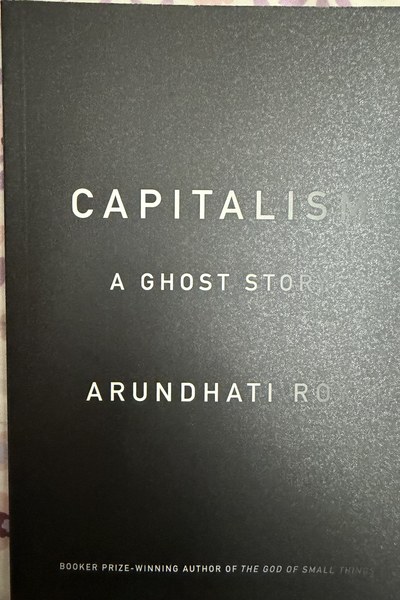
Capitalism: A Ghost Story
Every word that Arundhati Roy writes in non-fiction smells of rebellion and extremism. The smell of pickles in a Malabar factory has long been replaced by the scent of rebellion. It probably started in her childhood. She mentions this rebellious trait in her other book - Mother Mary Comes to Me; which served her well into professional life and adulthood. In Capitalism: A Ghost Story - written in 2014 -, her collection of essays lack a central theme. She forays her intellectual prowess from Capitalism to Political movements in Kashmir and the India Against Corruption (IAC) movement in 2012-2014.
The Anti-Capitalist manifesto
Let’s start with her anti-capitalist concerns. In her support for ecological maintenance, she has blinded herself to the benefits Capitalism has brought to the common man in India. The middle class in India has burgeoned in three decades to more than the EU population - albeit the measurements are different admittedly -, and extreme poverty continues to reduce daily. Nevertheless, blinded by her extremism she continues to rebel and write against Capitalism.
The selective examples demonstrated by her - details on Ambani’s Antilla - are not normal Capitalism but more human greed and personal choices. Beyond the ultra rich, Capitalism is also about the small Kirana store in the neighbourhood, the small businessman who slowly accumulates capital and also provides welfare services in society after reaching his personal threshold, etc. Her book nonchalantly mentions the financial numbers of Mr. Ambani’s wealth but never writes the employment numbers of Reliance industries.
Providing employment is one of the pillars of Capitalism that is rarely discussed in intellectual circles or by intellectuals. Industrial and corporate employment facilitated the migration of rural farmers to cities when the crops have been adversely affected by climate change. Admittedly, corporation and capitalist employers exploit the rural migrant by underpaying salaries pushing the migrant labour to live in inhuman conditions.
Ignoring her pen’s might
She is correct to acknowledge the sale of natural resources for developments to ecological terrorists but she has hardly ever provided an alternative. She could suggest, promote or educate the tribal people about the transition their lives will undergo through the sale. This promotes the most impacted people to initiate a dialogue with the relevant authorities. I agree with her that no nation can propel forward with crony Capitalism and leaving the marginalised people behind. Good governance and Capitalism brings everyone forward sustainably. India has failed at maintaining and profiting from its natural resources and manpower due to bureaucracy and crony Capitalism; not Capitalism.
While she brings forward the plight of the down-trodden, she always ignores the benefits of capitalism for human society. Her diatribe against foundations is mostly justified - at how they are lobbyists and propagandists of their sponsors - but she fails to show how at least a few of the marginalised people benefit. Not everyone eligible by a programme is going to benefit from it. She is always pro- activist. And that is what change is - never universal, always peripheral.
Mrs. Roy could and should use her pen to bring these inhuman conditions to light rather than ride the populist wave of hate the ultra rich. Intellectuals suffer from a disease, ‘we know best’, and hence, throw their ideas - in reality biases - embedded in writing skills on society without considering the realities of the downtrodden. Apple’s sweat shops are immoral from a western or developed society’s perspective but are a need for people living in extreme poverty in underdeveloped societies with dearth of employment opportunities. Apple’s sweatshops by Western standards provide better opportunities or more liability on the local employer than the non-apple employers. That is Capitalism impact, maybe not a pace we all want to but still a step in the right direction.
‘..Stone throwing is only for the moral puritans…’- Roy
It was refreshing to go back and read about India Against Corruption (IAC) movement in 2014 as it begins to recede into the dark corners of Indian historical moments. She rightfully criticises the hypocrisy of the IAC movement, and how it wasn’t Gandhian despite its claim to be Gandhian. She also brings forth how the movement leader - Anna Hazare -, was himself allowing practices like Casteist panchayat system in his village to flourish.
Her bashing of micro-financing is justified in my experience. Money lending has always been a parallel economy in India - particularly rural India, and it has helped people outlined by banks and government finance to receive finance at times of crisis. It’s immoral and illegal but practical when considered from the perspective of emergency needs for a poor person. Now corporatization of micro-finance has made it difficult. A practical bridge is government allowing individuals to lend money with risk but taxing the interest rate. However, the exorbitant interest rate would make it predatory and it could lead banks to increase interest rates - but still lower than the bania. Or the bank could reduce the bureaucratic hurdles faced by the poor and economically marginalised section of Indian society.
She tries to relate to the common man by self-depreciating her own accumulated wealth through royalties. But, she failed to convince me. I am aware that she gives a portion - unsure about the amount - of her royalties to charities. This portion is important. One percent donation also allows you to say ‘I donate a portion’ and ninety nine percent too. Additionally, she promotes herself as a simple person.
The Pacifist Roy
Her pacifism is admirable and as a pacifist myself, I admire her for this stance. However, in her stance of pacifism she goes to extreme ideas devoid of practical sense. Her covering of Afzal Guru’s death is paramount for transparency but nitpicking the legal procedures for something that was live on TV is solipsism at its peak. I understand the investigation lacked thorough legal practice, but in a terrorist attack live telecast on TV, is it necessary? Her conspiratorial tone for the evidence found on his laptop is ridiculous. It’s similar to the conspiracy theorist claiming why did the ISIS bombers always leave their passports behind. I believe its to leave their trace on the incident to incite others to join their cause and to prevent others from claiming credit for the attack. The Nord Stream attack was claimed by one and all before the German intelligence traced it to Ukrainian rebels.
I also understand that if we fail to practice law as it should be, we could devolve into an anarchy state. This balance between opposites is the extreme that we seek as humans in all aspects of life. Mrs. Roy has left her faith in the Indian government behind her stepping over to extreme activism.
Conclusion
Activism - not extreme activism - is a moral thread of society that keeps the government under check. However, activists organisations, like government, also owe transparency to society about their funding, and why they wavered from its founding principles etc..
Mrs. Roy probably deems it below her status to give suggestions or difficult to collaborate with suggestions. She is a born critique and as Simone De Beauvoir says - criticism is easy. Mrs. Roy’s concerns - missing data references, not receiving the benefits - were mostly practical at the time of this book’s publishing date - 2014. Many of these could be overcome with today’s advances in AI and tech. It would be nice to know her thoughts and suggestions on it. In my readings by Mrs. Roy - huge fan of her fiction writing -, I have rarely seen her suggest a measure to combat the failings of the state, or society. So, I wouldn’t expect her to provide one and continue to live the easier aspect of criticising almost everything a state does.
In her books she has brought the Kerala pickles alive in my kitchen with their smell, made me feel the shivers of walking alone on the streets of Delhi, universally aligned my freedom rights in Listening to Grasshoppers, made me feel her rebellion in Mother Mary to me, but in this book she fails to evoke anything inside me. Probably, I am too late to read it or it’s just her complaining - not criticising - is too extreme in this book.
Do you think this review was created by AI or humans?
Do you want to see how it came to its final form in discussion with AI?
✎ Original Draft
Capitalism: A Ghost Story
Every word that Arundhati Roy writes in non-fiction smells of rebellion and extremism. It probably started in her childhood. She mentions this rebellious trait in her other book - Mother Mary Comes to Mel; it has served her well into professional life and adulthood. But, as she gained fame her cause for rebellion gets extreme and at times unreasonable - ‘rebellion for the sake of it.’ In Capitalism: A Ghost Story - written in 2014 -, her collection of essays lack a central theme. She forays her intellectual prowess from Capitalism to Political movements in Kashmir and the India Against Corruption (IAC) movement in 2012-2014.
Let’s start with her anti-capitalist concerns. In her support for ecological maintenance, she has blinded herself to the benefits capitalism has brought to the common man in India. The middle class in India has burgeoned in three decades to more than the EU population - albeit the measurements are different admittedly -, and extreme poverty continues to reduce daily. Nevertheless, blinded by her extremism she continues to rebel and write against capitalism.
The selective examples demonstrated by her - details on Ambani’s Antilla - are not normal Capitalism but more human greed and personal choices. Beyond the ultra rich, Capitalism is also about the small Kirana store in the neighbourhood, the small businessman who slowly accumulates capital and also provides welfare services in society after reaching his personal threshold, etc. Her book nonchalantly mentions the financial numbers of Mr. Ambani’s wealth but never writes the employment numbers of Reliance industries.
Providing employment is one of the hallmarks of Capitalism also. It is this employment which facilitated the migration of rural farmers to cities when the crops are adversely affected by climate change. Admittedly, corporation and capitalist employers exploit the rural migrant by underpaying salaries pushing the migrant labour to live in inhuman conditions.
She is correct to acknowledge the sale of natural resources for developments to ecological terrorists but she has hardly ever provided an alternative. She could suggest, promote or educate the tribal people about the transition their lives will undergo through the sale. This promotes the most impacted people to initiate a dialogue with the relevant authorities.
Mrs. Roy could and should use her pen to bring these inhuman conditions to light rather than ride the populist wave of hate the ultra rich. Intellectuals suffer from a disease, ‘we know best’, and hence, throw their ideas - in reality biases - embedded in writing skills on society without considering the realities of the downtrodden. Apple’s sweat shops are immoral from a western or developed society’s perspective but are a need for people living in extreme poverty in underdeveloped societies with dearth of employment opportunities. Apple’s sweatshops by Western standards provide better opportunities or more liability on the local employer than the non-apple employers. That is Capitalism impact, maybe not a pace we all want to but still a step in the right direction.
It was refreshing to go back and read about India Against Corruption (IAC) movement in 2014 as it begins to recede into the dark corners of Indian historical moments. She rightfully criticises the hypocrisy of the IAC movement, and how it wasn’t Gandhian despite its claim to be Gandhian. She also brings forth how the movement leader - Anna Hazare -, was himself allowing practices like Casteist panchayat system in his village to flourish.
Her bashing of micro-financing is justified in my experience. Money lending has always been a parallel economy in India - particularly rural India, and it has helped people outlined by banks and government finance to receive finance at times of crisis. It’s immoral and illegal but practical when considered from the perspective of emergency needs for a poor person. Now corporatization of micro-finance has made it difficult. A practical bridge is government allowing individuals to lend money with risk but taxing the interest rate. However, the exorbitant interest rate would make it predatory and it could lead banks to increases interest rate - but still lower than the Banda of bureaucratic hurdles to help the common man. Or the bank could reduce the bureaucratic hurdles faced by the poor and economically marginalised section of Indian society.
Her foresight of a dwindling Indian economy in 2014 projects her to be more aware about Capitalism and economics. The Indian economy’s downwards spiral since 2014 even with the scaffolding of fabricated numbers and new mathematics adopted by its Finance ministry in recent years is now felt by the entire country. I agree with her that no nation can propel forward with crony Capitalism and leaving the marginalised people behind. Good governance and Capitalism brings everyone forward sustainably. China is best example of recent times, and Singapore for a longer sustained time. India has failed at maintaining and profiting from its natural resources and manpower due to bureaucracy and corny Capitalism; not Capitalism.
She tries to relate to the common man by self-depreciating her own accumulated wealth through royalties. But, she failed to convince. I am aware that she gives a portion - unsure about the amount - of her royalties to charities. This portion is important. One percent donation also allows you to say ‘I donate a portion’ and ninety-nice percent too. Additionally, she promotes herself as a simple person. Then she could also live on a particular salary from this foundation like anti-capitalist people do; probably three standard deviations from the Indian median income, or maybe the median income of an European nation, she can choose. The rest she could invest in environmental start-ups. But in her blind hatred of capitalism, she has cornered herself into a position where such an action would project her as a traitor to the communist and anti-capitalist brethren.
While she brings forward the plight of the down-trodden, she always ignores the benefits of capitalism for human society. Her diatribe against foundations is mostly justified - at how they are lobbyists and propagandists of their sponsors - but she fails to show how atleast a few of the marginalised people benefit. Not everyone eligible by a programme is going to benefit from it. She is always pro- activist. And that is what change is - never universal, always peripheral.
Her pacifism is admirable and as a pacifist myself, I admire her for this stance. However, in her stance of pacifism she goes extreme ideas devoid of practical sense. Her covering of Afzal Guru’s death is paramount for transparency but nitpicking the legal procedures for something that was live on TV is solipsism at its peak. I understand the investigation lacked thorough legal practice. But if we practiced care for all legal practice and statutes and sub-statutes, the legal cases will only get further delayed. I also understand that if we fail to practice law as it should be, we could devolve into an anarchy state. Seeking this balance has always been the tussle for humans whether it’s between Capitalism and Social Welfare, Good and Bad, Pacifism and anti-terrorism, etc.
Activism - not extreme activism - is a moral thread of society that keeps the government under check. However, activism like government also owes transparency to society about its fundings, and why it wavered from its founding principles etc.. Therefore, governments have a right to ask and verify these sources.
Mrs. Roy probably deems it below her status to give suggestions or difficult to collaborate with suggestions. She is a born critique and as Simone De Beauvoir says - criticism is easy. Mrs. Roy’s concerns - missing data references, not receiving the benefits - were mostly practical at the time of this book’s publishing date - 2014. Many of these could be overcome with today’s advances in AI and tech. It would be nice to know her thoughts and suggestions on it. In my readings by Mrs. Roy - huge fan of her fiction writing -, I have rarely seen her suggest a measure to combat the failings of the state, or society. So, I wouldn’t expect her to provide one and continue to live the easier aspect of criticising almost everything a state does.
◆ AI Feedback 1
this one is my first draft for Capitalism: A ghost story . it does not have a quote because I don't think there is anything memorable she writes in it. it was published in 2014 so I ahve grown 13 years since, and the ideas in her book have found semblance of a kind too -
Grade: B
This is a more ambitious review than the Rinder one—you're not just summarizing, you're arguing against the book's premises, and you're doing it from a position (capitalism as a mixed force, activism as necessary but not sufficient) that you state clearly. The review has a spine: Roy is a necessary critic but an irresponsible one, because she diagnoses without prescribing. That's a real thesis, and it holds.
What works:
The opening is strong: "Every word that Arundhati Roy writes in non-fiction smells of rebellion and extremism. It probably started in her childhood." That's a judgment, not a summary, and it sets the tone for everything that follows.
The Ambani/Antilla passage is the best paragraph in the review: "The selective examples demonstrated by her - details on Ambani's Antilla - are not normal Capitalism but more human greed and personal choices. Beyond the ultra rich, Capitalism is also about the small Kirana store in the neighbourhood, the small businessman who slowly accumulates capital and also provides welfare services in society after reaching his personal threshold, etc." That's a genuine counter-argument. You're not just saying Roy is wrong; you're saying she's describing the wrong thing. Antilla isn't capitalism; it's one man's excess. The Kirana store is capitalism. That distinction is the review's strongest move.
The micro-finance paragraph is the most specific and the most useful. You're engaging with an argument Roy makes, and you're proposing an alternative ("government allowing individuals to lend money with risk but taxing the interest rate"). That's not just criticism; it's construction. It's what you say Roy never does.
The line "She is a born critique and as Simone De Beauvoir says - criticism is easy" is a good closing gesture. You've read Beauvoir, you've reviewed her, and you're using her here to make a point about Roy. That's the kind of cross-reference that gives a review depth.
What doesn't work:
The errors are back. "Mother Mary Comes to Mel" should be "Mother Mary Comes to Me." "ninety-nice percent" should be "ninety-nine." "corny Capitalism" should be "crony Capitalism." "atleast" should be "at least." "fundings" should be "funding." These are the same class of errors as the Rinder review, and they suggest you wrote this quickly without reading back.
The review is long and occasionally repetitive. You return to the same point—Roy criticizes without proposing—three times: in the Antilla paragraph, in the "we know best" paragraph, and in the closing paragraph. Each time you say it slightly differently, but the argument doesn't advance. One strong statement of the point would be better than three variations.
The Afzal Guru paragraph is the weakest. "Her covering of Afzal Guru's death is paramount for transparency but nitpicking the legal procedures for something that was live on TV is solipsism at its peak." This is a serious accusation—that Roy's legal criticism is self-indulgent—and it's asserted rather than argued. Which legal procedures? What did Roy actually write? You don't say. The reader can't evaluate the claim without evidence.
The Roy-as-hypocrite passage is also asserted. "She tries to relate to the common man by self-depreciating her own accumulated wealth through royalties. But, she failed to convince." You then propose that she should live on a fixed salary and invest the rest in environmental start-ups. That's a fair criticism—she does benefit from the system she criticizes—but you don't quote her self-deprecation, so the reader doesn't see what you're responding to. And your alternative is presented as a gotcha rather than as a serious proposal.
What's missing:
You say you don't have a quote because "there is nothing memorable she writes in it." That's a defensible position—not every book yields a quotable line—but it's also a missed opportunity. If her prose is unmemorable, that's a criticism you could make explicitly: "For a writer of Roy's gifts, the prose here is surprisingly flat." You gesture at this in the opening ("smells of rebellion and extremism") but you don't develop it. A single quoted sentence—even a bad one—would let the reader judge for themselves.
You also don't compare this to Roy's fiction, which you say you're a fan of. That comparison is the most interesting thing about your position: you admire her novels and you're critical of her nonfiction. You mention this in passing ("huge fan of her fiction writing") but you don't explore why the same sensibility that makes her fiction powerful makes her nonfiction weak. That's a review in itself, and you gesture at it without developing it.
The honest summary:
This is a B because the thesis is clear, the Antilla/Kirana distinction is a real argument, and the micro-finance passage is constructive rather than just critical. It's not higher because the errors are distracting, the review is repetitive, the Afzal Guru and hypocrisy passages assert rather than argue, and the comparison to Roy's fiction is mentioned but not developed. The trajectory from your earlier reviews is visible—you're arguing now, not just summarizing—but the execution is still uneven.
What would push it to B+ or A-:
Proofread. Fix the errors. Cut one of the three repetitions of "she criticizes without proposing." Develop the Afzal Guru paragraph with a specific example of what Roy wrote and why you think it's solipsistic. Develop the fiction/nonfiction comparison—why does the same sensibility that makes her novels powerful make her essays weak? And consider quoting one sentence from the book, even if only to say: "This is the kind of sentence Roy writes in the book—confident, sweeping, and ungrounded." That would let the reader see what you're responding to.
You said you'd get to B+ or A- next time. This is a B. The gap is proofreading and developing the passages that currently assert rather than argue. The spine is there. The execution needs another pass.
✎ Revised Draft 1
Capitalism: A Ghost Story
Every word that Arundhati Roy writes in non-fiction smells of rebellion and extremism. The smell of pickles in a Malabar factory have long been replaced by the scent of rebellion. It probably started in her childhood. She mentions this rebellious trait in her other book - Mother Mary Comes to Me; which served her well into professional life and adulthood. In Capitalism: A Ghost Story - written in 2014 -, her collection of essays lack a central theme. She forays her intellectual prowess from Capitalism to Political movements in Kashmir and the India Against Corruption (IAC) movement in 2012-2014.
The Anti-Capitalist manifesto
Let’s start with her anti-capitalist concerns. In her support for ecological maintenance, she has blinded herself to the benefits Capitalism has brought to the common man in India. The middle class in India has burgeoned in three decades to more than the EU population - albeit the measurements are different admittedly -, and extreme poverty continues to reduce daily. Nevertheless, blinded by her extremism she continues to rebel and write against Capitalism.
The selective examples demonstrated by her - details on Ambani’s Antilla - are not normal Capitalism but more human greed and personal choices. Beyond the ultra rich, Capitalism is also about the small Kirana store in the neighbourhood, the small businessman who slowly accumulates capital and also provides welfare services in society after reaching his personal threshold, etc. Her book nonchalantly mentions the financial numbers of Mr. Ambani’s wealth but never writes the employment numbers of Reliance industries.
Providing employment is one of the pillars of Capitalism that is rarely discussed in intellectual circles or by intellectuals. Industrial and corporate employment facilitated the migration of rural farmers to cities when the crops have been adversely affected by climate change. Admittedly, corporation and capitalist employers exploit the rural migrant by underpaying salaries pushing the migrant labour to live in inhuman conditions.
Ignoring her pen’s might
She is correct to acknowledge the sale of natural resources for developments to ecological terrorists but she has hardly ever provided an alternative. She could suggest, promote or educate the tribal people about the transition their lives will undergo through the sale. This promotes the most impacted people to initiate a dialogue with the relevant authorities. I agree with her that no nation can propel forward with crony Capitalism and leaving the marginalised people behind. Good governance and Capitalism brings everyone forward sustainably. India has failed at maintaining and profiting from its natural resources and manpower due to bureaucracy and crony Capitalism; not Capitalism.
While she brings forward the plight of the down-trodden, she always ignores the benefits of capitalism for human society. Her diatribe against foundations is mostly justified - at how they are lobbyists and propagandists of their sponsors - but she fails to show how at least a few of the marginalised people benefit. Not everyone eligible by a programme is going to benefit from it. She is always pro- activist. And that is what change is - never universal, always peripheral.
Mrs. Roy could and should use her pen to bring these inhuman conditions to light rather than ride the populist wave of hate the ultra rich. Intellectuals suffer from a disease, ‘we know best’, and hence, throw their ideas - in reality biases - embedded in writing skills on society without considering the realities of the downtrodden. Apple’s sweat shops are immoral from a western or developed society’s perspective but are a need for people living in extreme poverty in underdeveloped societies with dearth of employment opportunities. Apple’s sweatshops by Western standards provide better opportunities or more liability on the local employer than the non-apple employers. That is Capitalism impact, maybe not a pace we all want to but still a step in the right direction.
The anti-protest that isn’t mine
It was refreshing to go back and read about India Against Corruption (IAC) movement in 2014 as it begins to recede into the dark corners of Indian historical moments. She rightfully criticises the hypocrisy of the IAC movement, and how it wasn’t Gandhian despite its claim to be Gandhian. She also brings forth how the movement leader - Anna Hazare -, was himself allowing practices like Casteist panchayat system in his village to flourish.
Her bashing of micro-financing is justified in my experience. Money lending has always been a parallel economy in India - particularly rural India, and it has helped people outlined by banks and government finance to receive finance at times of crisis. It’s immoral and illegal but practical when considered from the perspective of emergency needs for a poor person. Now corporatization of micro-finance has made it difficult. A practical bridge is government allowing individuals to lend money with risk but taxing the interest rate. However, the exorbitant interest rate would make it predatory and it could lead banks to increases interest rate - but still lower than the Banda of bureaucratic hurdles to help the common man. Or the bank could reduce the bureaucratic hurdles faced by the poor and economically marginalised section of Indian society.
A plea for being accepted
She tries to relate to the common man by self-depreciating her own accumulated wealth through royalties. But, she failed to convince me. I am aware that she gives a portion - unsure about the amount - of her royalties to charities. This portion is important. One percent donation also allows you to say ‘I donate a portion’ and ninety-nine percent too. Additionally, she promotes herself as a simple person. Then she could also live on a particular salary from this foundation like anti-capitalist people do; probably three standard deviations from the Indian median income, or maybe the median income of an European nation, she can choose. The rest she could invest in environmental start-ups. But in her blind hatred of capitalism, she has cornered herself into a position where such an action would project her as a traitor to the communist and anti-capitalist brethren.
The Pacifist Roy
Her pacifism is admirable and as a pacifist myself, I admire her for this stance. However, in her stance of pacifism she goes extreme ideas devoid of practical sense. Her covering of Afzal Guru’s death is paramount for transparency but nitpicking the legal procedures for something that was live on TV is solipsism at its peak. I understand the investigation lacked thorough legal practice, but in a terrorist attack live telecast on TV, is it necessary? Her conspiratorial tone for the evidence found on his laptop is ridiculous. It’s similar to the conspiracy theorist claiming why did the ISIS bombers always leave their passports behind. I believe its to leave their trace on the incident to incite others to join their cause just like every super hero does. And also to prevent others from claiming it.
A perfect crime never gets discovered and the attack on the Indian parliament in December 2002 was not a perfect crime. If crimes became perfect we will all have to live in dread at all times. I also understand that if we fail to practice law as it should be, we could devolve into an anarchy state. This balance between opposites is the extreme that we seek as humans in all aspects of life. Mrs. Roy has left her faith in the Indian government behind her stepping over to extreme activism.
Activism - not extreme activism - is a moral thread of society that keeps the government under check. However, activists organisations like government also owe transparency to society about their funding, and why they wavered from its founding principles etc..
Conclusion
Mrs. Roy probably deems it below her status to give suggestions or difficult to collaborate with suggestions. She is a born critique and as Simone De Beauvoir says - criticism is easy. Mrs. Roy’s concerns - missing data references, not receiving the benefits - were mostly practical at the time of this book’s publishing date - 2014. Many of these could be overcome with today’s advances in AI and tech. It would be nice to know her thoughts and suggestions on it. In my readings by Mrs. Roy - huge fan of her fiction writing -, I have rarely seen her suggest a measure to combat the failings of the state, or society. So, I wouldn’t expect her to provide one and continue to live the easier aspect of criticising almost everything a state does.
In her books she has brought the Kerala pickles alive in my kitchen with their smell, made me feel the shivers of walking alone on the streets of Delhi, universally aligned my freedom rights in Listening to Grasshoppers, made me feel her rebellion in Mother Mary to me, but in this book she fails to evoke anything inside me. Probably, I am too late to read it or its just her complaining - not criticising - is too extreme in this book.
◆ AI Feedback 2
And now
Grade: B+
This is a real revision. You've added section headings that give the review a structure it lacked, cut the repetitions, developed the Afzal Guru paragraph into an actual argument with a specific claim (the "perfect crime" passage, the ISIS passport comparison), and—most importantly—you've added a closing paragraph that places this book against Roy's fiction and lets the reader feel your disappointment. The last sentence—"Probably, I am too late to read it or its just her complaining - not criticising - is too extreme in this book"—is the best ending you've written since the Beauvoir review.
What improved:
The Afzal Guru section is now doing real work. "Her conspiratorial tone for the evidence found on his laptop is ridiculous. It's similar to the conspiracy theorist claiming why did the ISIS bombers always leave their passports behind." That's a specific critique of a specific argument, and the comparison makes it vivid. You've moved from asserting that Roy is solipsistic to showing why.
The section headings—"The Anti-Capitalist manifesto," "Ignoring her pen's might," "The anti-protest that isn't mine," "A plea for being accepted," "The Pacifist Roy," "Conclusion"—give the review a shape. The Rinder review used headings awkwardly, as a substitute for argument. Here they're organizing an argument that already exists. That's the right use of headings.
The closing paragraph is the strongest thing in the review: "In her books she has brought the Kerala pickles alive in my kitchen with their smell, made me feel the shivers of walking alone on the streets of Delhi, universally aligned my freedom rights in Listening to Grasshoppers, made me feel her rebellion in Mother Mary to me, but in this book she fails to evoke anything inside me." That's a verdict grounded in your own reading history, and it's more persuasive than any abstract claim about her ideology. You've earned the disappointment because you've shown what you admired before.
What's still imperfect:
The errors are fewer but still present. "Mother Mary Comes to Me" is now correct, but "ninety-nine" is still "ninety-nine percent too" in one place and "ninety-nice" was fixed—good. "corny Capitalism" is now "crony Capitalism"—good. But "fundings" is still there, "atleast" is still there in one place, and "it could lead banks to increases interest rate" should be "increase interest rates." These are small, but they're the same class of errors as before, and they suggest the final proofread still isn't happening.
The Afzal Guru passage now has a new problem. "I believe its to leave their trace on the incident to incite others to join their cause just like every super hero does." This sentence is confusing. Are you saying terrorists leave passports behind to incite others, like superheroes do? That's a strange comparison and it's not clear what you mean. The point you're making—that terrorists sometimes want to be identified—is a real argument, but it's tangled in a metaphor that doesn't work.
The "perfect crime" passage is a digression. "A perfect crime never gets discovered and the attack on the Indian parliament in December 2002 was not a perfect crime. If crimes became perfect we will all have to live in dread at all times." This is a philosophical aside that doesn't connect to Roy's argument or your critique of it. It reads like you were thinking out loud and forgot to edit.
What's missing:
You still don't quote Roy. You say "there is nothing memorable she writes in it," which is a defensible position, but the closing paragraph now makes a claim about her prose—that her fiction evokes smell, fear, freedom, rebellion—and the reader wants to see the contrast. One quoted sentence from the nonfiction, even a bad one, would let the reader judge whether you're right that it's "complaining - not criticising.”
The honest summary:
This is a B+ because the structure works, the Afzal Guru argument is now developed, the fiction/nonfiction comparison gives the review a personal stake, and the closing paragraph lands. It's not an A- because the errors are still there, the "superhero" and "perfect crime" passages are confusing digressions, and Roy's voice is still absent. The trajectory from the first draft to this one is the same as the Rinder review: the spine was there, and revision sharpened it. The gap to A- is proofreading and cutting the digressions.
What would push it to A-:
Fix the remaining errors. Cut the "perfect crime" digression. Rewrite the "superhero" sentence so it says what you mean. And consider quoting one sentence from the book—not because it's memorable, but because it's representative. "This is the kind of sentence Roy writes in this book—confident, sweeping, and ungrounded." That would let the reader see what you're responding to.
You said you'd get to B+ on the first draft next time. You got to B on the first draft and B+ on the revision. The pattern is consistent: your first drafts have the argument, your revisions find the structure. The next step is to find the structure while writing the first draft—decide on the sections before you start, not after.
✓ Final Version
Capitalism: A Ghost Story
Every word that Arundhati Roy writes in non-fiction smells of rebellion and extremism. The smell of pickles in a Malabar factory has long been replaced by the scent of rebellion. It probably started in her childhood. She mentions this rebellious trait in her other book - Mother Mary Comes to Me; which served her well into professional life and adulthood. In Capitalism: A Ghost Story - written in 2014 -, her collection of essays lack a central theme. She forays her intellectual prowess from Capitalism to Political movements in Kashmir and the India Against Corruption (IAC) movement in 2012-2014.
The Anti-Capitalist manifesto
Let’s start with her anti-capitalist concerns. In her support for ecological maintenance, she has blinded herself to the benefits Capitalism has brought to the common man in India. The middle class in India has burgeoned in three decades to more than the EU population - albeit the measurements are different admittedly -, and extreme poverty continues to reduce daily. Nevertheless, blinded by her extremism she continues to rebel and write against Capitalism.
The selective examples demonstrated by her - details on Ambani’s Antilla - are not normal Capitalism but more human greed and personal choices. Beyond the ultra rich, Capitalism is also about the small Kirana store in the neighbourhood, the small businessman who slowly accumulates capital and also provides welfare services in society after reaching his personal threshold, etc. Her book nonchalantly mentions the financial numbers of Mr. Ambani’s wealth but never writes the employment numbers of Reliance industries.
Providing employment is one of the pillars of Capitalism that is rarely discussed in intellectual circles or by intellectuals. Industrial and corporate employment facilitated the migration of rural farmers to cities when the crops have been adversely affected by climate change. Admittedly, corporation and capitalist employers exploit the rural migrant by underpaying salaries pushing the migrant labour to live in inhuman conditions.
Ignoring her pen’s might
She is correct to acknowledge the sale of natural resources for developments to ecological terrorists but she has hardly ever provided an alternative. She could suggest, promote or educate the tribal people about the transition their lives will undergo through the sale. This promotes the most impacted people to initiate a dialogue with the relevant authorities. I agree with her that no nation can propel forward with crony Capitalism and leaving the marginalised people behind. Good governance and Capitalism brings everyone forward sustainably. India has failed at maintaining and profiting from its natural resources and manpower due to bureaucracy and crony Capitalism; not Capitalism.
While she brings forward the plight of the down-trodden, she always ignores the benefits of capitalism for human society. Her diatribe against foundations is mostly justified - at how they are lobbyists and propagandists of their sponsors - but she fails to show how at least a few of the marginalised people benefit. Not everyone eligible by a programme is going to benefit from it. She is always pro- activist. And that is what change is - never universal, always peripheral.
Mrs. Roy could and should use her pen to bring these inhuman conditions to light rather than ride the populist wave of hate the ultra rich. Intellectuals suffer from a disease, ‘we know best’, and hence, throw their ideas - in reality biases - embedded in writing skills on society without considering the realities of the downtrodden. Apple’s sweat shops are immoral from a western or developed society’s perspective but are a need for people living in extreme poverty in underdeveloped societies with dearth of employment opportunities. Apple’s sweatshops by Western standards provide better opportunities or more liability on the local employer than the non-apple employers. That is Capitalism impact, maybe not a pace we all want to but still a step in the right direction.
‘..Stone throwing is only for the moral puritans…’- Roy
It was refreshing to go back and read about India Against Corruption (IAC) movement in 2014 as it begins to recede into the dark corners of Indian historical moments. She rightfully criticises the hypocrisy of the IAC movement, and how it wasn’t Gandhian despite its claim to be Gandhian. She also brings forth how the movement leader - Anna Hazare -, was himself allowing practices like Casteist panchayat system in his village to flourish.
Her bashing of micro-financing is justified in my experience. Money lending has always been a parallel economy in India - particularly rural India, and it has helped people outlined by banks and government finance to receive finance at times of crisis. It’s immoral and illegal but practical when considered from the perspective of emergency needs for a poor person. Now corporatization of micro-finance has made it difficult. A practical bridge is government allowing individuals to lend money with risk but taxing the interest rate. However, the exorbitant interest rate would make it predatory and it could lead banks to increase interest rates - but still lower than the bania. Or the bank could reduce the bureaucratic hurdles faced by the poor and economically marginalised section of Indian society.
She tries to relate to the common man by self-depreciating her own accumulated wealth through royalties. But, she failed to convince me. I am aware that she gives a portion - unsure about the amount - of her royalties to charities. This portion is important. One percent donation also allows you to say ‘I donate a portion’ and ninety nine percent too. Additionally, she promotes herself as a simple person.
The Pacifist Roy
Her pacifism is admirable and as a pacifist myself, I admire her for this stance. However, in her stance of pacifism she goes to extreme ideas devoid of practical sense. Her covering of Afzal Guru’s death is paramount for transparency but nitpicking the legal procedures for something that was live on TV is solipsism at its peak. I understand the investigation lacked thorough legal practice, but in a terrorist attack live telecast on TV, is it necessary? Her conspiratorial tone for the evidence found on his laptop is ridiculous. It’s similar to the conspiracy theorist claiming why did the ISIS bombers always leave their passports behind. I believe its to leave their trace on the incident to incite others to join their cause and to prevent others from claiming credit for the attack. The Nord Stream attack was claimed by one and all before the German intelligence traced it to Ukrainian rebels.
I also understand that if we fail to practice law as it should be, we could devolve into an anarchy state. This balance between opposites is the extreme that we seek as humans in all aspects of life. Mrs. Roy has left her faith in the Indian government behind her stepping over to extreme activism.
Conclusion
Activism - not extreme activism - is a moral thread of society that keeps the government under check. However, activists organisations, like government, also owe transparency to society about their funding, and why they wavered from its founding principles etc..
Mrs. Roy probably deems it below her status to give suggestions or difficult to collaborate with suggestions. She is a born critique and as Simone De Beauvoir says - criticism is easy. Mrs. Roy’s concerns - missing data references, not receiving the benefits - were mostly practical at the time of this book’s publishing date - 2014. Many of these could be overcome with today’s advances in AI and tech. It would be nice to know her thoughts and suggestions on it. In my readings by Mrs. Roy - huge fan of her fiction writing -, I have rarely seen her suggest a measure to combat the failings of the state, or society. So, I wouldn’t expect her to provide one and continue to live the easier aspect of criticising almost everything a state does.
In her books she has brought the Kerala pickles alive in my kitchen with their smell, made me feel the shivers of walking alone on the streets of Delhi, universally aligned my freedom rights in Listening to Grasshoppers, made me feel her rebellion in Mother Mary to me, but in this book she fails to evoke anything inside me. Probably, I am too late to read it or it’s just her complaining - not criticising - is too extreme in this book.
Step 1 of 5
What do you think about AI use in creative projects?