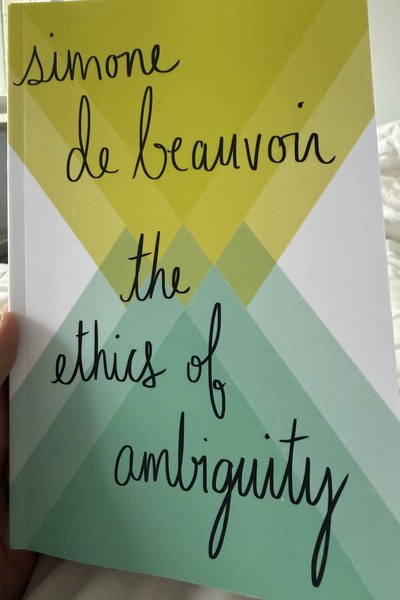
The Ethics of Ambiguity
Free people allow, even push, others to be free. I cannot think anything else is better to start the review of The Ethics of Ambiguity, because this is the hinge on which Simone de Beauvoir’s whole argument turns: to want my own freedom honestly is already to want yours. Freedom, for her, only makes sense in a world shared with others.
Written in 1947 in the wake of world war two, when existentialism was being dismissed as gloomy and amoral, the book sets out to show that philosophy without God or fixed human nature can still produce an ethical society. Beauvoir starts from what she calls our ambiguity: we are free subjects who make meaning, and at the same time bodies, objects, and pieces of a history we did not choose.
What makes the book remarkable is its universal reach. In barely a hundred and fifty pages Beauvoir moves through free will, childhood, political violence, revolutions and the uses of history, themes as old society itself. Yet at no point does she lose the common reader, the one with no background in philosophy or political history. Her examples come from ordinary life and from the wars - the two world wars -, and revolutions - communist revolution in USSR and China -, her contemporary readers had just lived through, and the prose stays clear even when the ideas are hard. The ideas still holds more relevance today as more tyrants re-emerge into prominence.
With her brilliant prose, she makes the reader feel the chains they have accepted from society and history, chains that keep them from becoming truly free. She begins with the child, who lives in a world of ready-made values handed down by adults. The child is not to blame for this, the adult who goes on living that way is.
From there she sketches a gallery of people who flee their freedom. The sub-man drifts through life avoiding a real commitment. The serious man hands his freedom over to a cause, a party, a nation or money, and treats it as an absolute that justifies anything. The nihilist, disappointed that nothing is worth anything, decides nothing matters. The adventurer loves actions for their own sake and is indifferent to where it leads. The passionate man fixes on one object and sacrifices others to it.
The reader will recognise some of themselves in each portrait, and that is the point. Beauvoir is not mocking these types. She shows how each is a comfortable way of escaping the anxiety of choosing, and how each, used far enough, becomes willing to use other people as tools.
In making her case, she does not demolish earlier ideas of freedom. She points to their flaws and keeps what is useful. Is the Stoic’s calm acceptance of whatever happens really freedom, or is it indifference dressed up as wisdom? A freedom that retreats inward and lets the world go on, in her view, giving up the very thing that makes it freedom: the power to act and change things. We as humans never exercise our power to say no to change a status quo even in modern times.
She is just as sharp with what she calls the aesthetic attitude, the habit of standing back from history and contemplating it like a spectacle. Her pages on writers such as Goethe, Barres, ask an uncomfortable question - If, once a struggle is lost, I can calmly admire the outcome or settle in with the winning side, was I ever really committed to anything? Detachment, she suggests, is often just a polished way of escaping responsibility.
In holding back from easy dismissal, Beauvoir lives out the old French saying that criticism is easy but art is difficult. She never gives up her intellectual rigour, yet she uses it to build rather than to score points. Her criticism is short and precise, plays in service of her own construction: an ethics in which freedom must be taken up in the world, alongside and for sake of others.
The central theme of the book is how free people, acting in the name of freedom, become tyrants and oppressors without realising it. Just as the reader begins to grasp what freedom means, Beauvoir is careful to show them where it can lead. A truly free person works for the freedom of others. But to free the oppressed, the liberator must often fight, coerce and sacrifice, and in doing so becomes an oppressor in turn. This is an inconvenient truth about the human society and political systems, and she refuses to look away from it.
She labels these as antinomies of action. Every revolution must decide how many people of today may be sacrificed for the people of tomorrow, and every such decision treats some human beings as means. The great danger, for her, is the moment a movement makes its goal absolute: the classless society, the nation, history’s verdict. Once the end is sacred, any means can be justified, and the people standing in the way stop counting as free subjects at all. The revolutionary has quietly become the serious man she warned about earlier.
Beauvoir’s answer is not to give up on action, which would only leave existing oppression in place. It is to keep the ambiguity alive: to act while never forgetting that the end does not automatically justify themes, and that each sacrifice must be weighed, questioned and owned. Freedom stays honest only so long as it keeps asking whether it is still serving freedom.
Her treatment of revolution, change and rebellion is more practical than Albert Camus’s in The Rebel. Camus, writing four years later in 1951, gives us an ideal rebel who sets moral limits on revolt. Beauvoir works closer to the ground, with concrete cases from the Resistance, the occupation and the revolutions of her century, and she admits more openly that clean hands may not be possible.
The book is not an easy book to live by, but it is an easy book to read, and that combination is rare. It makes you experience philosophy without the complications that Kant or Sartre project in their philosophical ideas. It makes you smile at your own dark flawed philosophical thoughts without taking you to the gallows of melancholy like Dostoevsky did. It isn’t pretentious like Kierkegaard, nor does it want us to kill desires or abstain like a Stoic, but it wants us to celebrate ourselves, nature and the ordinary objects of daily life that exist around us.
In its simplicity and ease lies its weakness i.e. the flip side of its strength: the readers looking for firm rules will find only a demand to keep thinking, judging and taking responsibility case by case. Most people find that frustrating and mentally exhausting because we have forgotten to exist as free humans. Caught between the mortgages and debts we exist as free thinkers who repeat the ideas of others as their own - whether in praise of art or criticism of the government.
Yet that refusal of easy answers is exactly what makes the book feel current. In an age of movements, states and causes that are certain of their own righteousness, Beauvoir’s warning still lands. Freedom that forgets other people’s freedom turns into its opposite. Anyone who has ever believed they were fighting for a good cause should read it, and then read it again.
Beauvoir writes her own freedom on the last page ‘Do what you must, come what may?’
Do you think this review was created by AI or humans?
Do you want to see how it came to its final form in discussion with AI?
✎ Original Draft
The Ethics of Ambiguity
Free people allow, even push, others to be free. I cannot think anything else is better to start the review of The Ethics of Ambiguity, because this is the hinge on which Simone de Beauvoir’s whole argument turns: to want my own freedom honestly is already to want yours. Freedom, for her, only makes sense in a world shared with others.
Written in 1947 in the wake of world war two, when existentialism was being dismissed as gloomy and amoral, the book sets out to show that philosophy without God or fixed human nature can still produce an ethical society. Beauvoir starts from what she calls our ambiguity: we are free subjects who make meaning, and at the same time bodies, objects, and pieces of a history we did not choose.
What makes the book remarkable is its universal reach. In barely a hundred and fifty pages Beauvoir moves through free will, childhood, political violence, revolutions and the uses of history, themes as old society itself. Yet at no point does she lose the common reader, the one with no background in philosophy or political history. Her examples come from ordinary life and from he wars - the two world wars -, and revolutions - communist revolution in USSR and China -, her contemporary readers had just lived through, and the prose stays clear even when the ideas are hard. The ideas still holds relevance and dare I say even more as tyrants re-emerge into prominence.
With her brilliant prose, she makes the reader feel the chains they have accepted from society and history, chains that keep them from becoming truly free. She begins with the child, who lives in a world of ready-made values handed down by adults. The child is not to blame for this, the adult who goes on living that way is.
From there she sketches a gallery of people who flee their freedom. The sub-man drifts through life avoiding a real commitment. The serious man hands his freedom over to a cause, a party, a nation or money, and treats it as an absolute that justifies anything. The nihilist, disappointed that nothing is even, decides nothing matters. The adventurer loves actions for its own sake and is indifferent to where it leads. The passionate man fixes on one object and sacrifices others to it.
The reader will recognise some of themselves in each portrait, and that is the point. Beauvoir is not mocking these types. She shows how each is a comfortable way of escaping the anxiety of choosing, and how each, used far enough, becomes willing to use other people as tools.
In making her case, she does not demolish earlier ideas of freedom. She points to their flaws and keeps what is useful. Is the Stoic’s calm acceptance of whatever happens really freedom, or is it indifference dressed up as wisdom? A freedom that retreats inward and lets the world on as it likes has, in her view, given up the very thing that makes it freedom: the power to act and change things. We as humans never exercise our power to say no to change a status quo even in modern times.
She is just as sharp with what she calls the aesthetic attitude, the habit of standing back from history and contemplating it like a spectacle. Her pages on writers such as Goethe, Barres, ask an uncomfortable question - If, once a struggle is lost, I can calmly admire the outcome or settle in with the winning side, was I ever really committed to anything? Detachment, she suggests, is often just a polished way of escaping responsibility.
In holding back from easy dismissal, Beauvoir lives out the old French saying that criticism is easy but art is difficult. She never gives up her intellectual rigour, yet she uses it to build rather than to score points. Her criticism is short and precise, plays in service of own construction: an ethics in which freedom must be taken up in the world, alongside and for sake of others.
The central theme of the book is how free people, acting in the name of freedom, become tyrants and oppressors without realising it. Just as the reader begins to grasp what freedom means, Beauvoir is careful to show them where it can lead. A truly free person works for the freedom of others. But to free the oppressed, the liberator must often fight, coerce and sacrifice, and in doing so becomes an oppressor in turn. This is an inconvenient truth about the human society and political systems, and she refuses to look away from it.
She labels theses as antinomies of action. Every revolution must decide how many people of today may be sacrificed for the people of tomorrow, and every such decision treats some human beings as means. The great danger, for her, is the moment a movement makes tis goal absolute: the classless society, the nation, history’s verdict. Once the end is sacred, any means can be justified, and the people standing in the way stop counting as free subjects at all. The revolutionary has quietly become the serious man she about earlier.
Beauvoir’s answer is not to give up on action, which would only leave existing oppression in place. It is to keep the ambiguity alive: to act while never forgetting that the end does not automatically justify themes, and that each sacrifice must be weighted, questioned and owned. Freedom stays honest only so long as it keeps asking whether it is still serving freedom.
Her treatment of revolution, change and rebellion is more practical than Albert Camus’s in The Rebel. Camus, writing four yeas later in 1951, gives us an ideal reel who sets moral limits on revolt. Beauvoir works closer to the ground, with concrete cases from the Resistance, the occupation and the revolutions of her century, and she admits more openly that clean hands may not be possible.
The book is not an easy book to live by, but it is an easy book to read, and that combination is rare. It makes you experience philosophy without the complications that Kant or Sartre project in their philosophical ideas. It makes you smile at your own dark flawed philosophical thoughts without taking you to the gallows of melancholy like Dostoevsky did. It isn’t pretentious like Kiekergaard, nor does it want us to kill desires or abstain like a Stoic, but it wants us to celebrate ourselves, nature and the things.
In its simplicity and ease lies its weakness i.e. the flip side of its strength: the readers looking for firm rules will find only a demand to keep thinking, judging and taking responsibility case by case. Most find that frustrating and mentally exhausting because we have forgotten to exist.
Yet that refusal of easy answers is exactly what makes the book feel current. In an age of movements, states and causes that are certain of their own righteousness, Beauvoir’s warning still lands. Freedom that forgets other people’s freedom turns into its opposite. Anyone who has ever believed they were fighting for a good cause should read it, and then read it again.
◆ AI Feedback 1
tell me your feedback and rating
Grade: A-
This is the strongest first draft you've submitted. Not because the prose is flawless—it isn't—but because the review has a clear thesis, a coherent structure, and a voice that is distinctly yours. You've read the book carefully and you're arguing about it, not just describing it. The trajectory across your reviews is visible: the Bakan draft had no argument, the Carr draft had a buried one, the No Longer at Ease draft found its spine in revision, and this one arrives with a spine on the first attempt.
What works:
The opening sentence is excellent: "Free people allow, even push, others to be free. I cannot think anything else is better to start the review of The Ethics of Ambiguity, because this is the hinge on which Simone de Beauvoir's whole argument turns: to want my own freedom honestly is already to want yours." That's a thesis statement that tells the reader what the book argues and what your review will argue. It's confident and precise.
The typology of people who flee their freedom—"the sub-man," "the serious man," "the nihilist," "the adventurer," "the passionate man"—is presented with a clarity that shows you understood Beauvoir's categories rather than just copying them. And "The reader will recognise some of themselves in each portrait, and that is the point" is the kind of sentence that makes a review personal without being self-indulgent.
The section on the antinomies of action is the intellectual heart of the review: "Every revolution must decide how many people of today may be sacrificed for the people of tomorrow, and every such decision treats some human beings as means." That's Beauvoir's hardest problem stated in one sentence, and you follow it with the consequence: "Once the end is sacred, any means can be justified, and the people standing in the way stop counting as free subjects at all. The revolutionary has quietly become the serious man she warned about earlier." That's a genuine critical insight—you've connected her typology to her political argument.
The comparison to Camus is well-placed and specific. You don't just name-drop The Rebel; you say what Camus does (sets moral limits on revolt) and what Beauvoir does differently (works closer to the ground, admits clean hands may not be possible). That's comparative criticism, not decoration.
The closing paragraph is the best ending you've written for any review. "In an age of movements, states and causes that are certain of their own righteousness, Beauvoir's warning still lands. Freedom that forgets other people's freedom turns into its opposite. Anyone who has ever believed they were fighting for a good cause should read it, and then read it again." That's a verdict, an argument, and a recommendation all at once. It earns its place as the last line.
What doesn't work:
The errors are still there, and there are enough to distract. "at the same time bodies" (missing comma), "he wars" (the wars), "even more as tyrants re-emerge" (this sentence is missing a verb—"holds relevance and dare I say even more" doesn't parse), "nothing is even" (nothing is worth anything?), "actions for its own sake" (their own sake), "lets the world on as it likes" (goes on), "The great danger, for her, is the moment a movement makes tis goal absolute" (its), "the serious man she about earlier" (she warned about), "each sacrifice must be weighted" (weighed), "four yeas later" (years), "an ideal reel" (ideal?), "Kiekergaard" (Kierkegaard), "the things" (this phrase is vague), "Most find that frustrating" (missing "people"), "we have forgotten to exist" (this is a genuine philosophical claim but it's stated as an aside and never developed).
These are the same class of errors as the Rinder review. They suggest you're writing fast and not reading back. The analysis is strong enough that a reader will push through, but every error is a small rupture in the reading experience. You said you'd work on proofreading. This is the draft where it would have mattered most, because the argument deserves better than the errors it's carrying.
What's missing:
You never quote Beauvoir. Not one line. For a review of a philosopher whose power is in her prose—you praise her style repeatedly—the reader never sees a sentence of it. The Achebe and Bryson reviews earned their grades by ending on the author's words. This one ends on yours, and yours are good, but Beauvoir's would have been better. One quote—from the child section, or the antinomies passage, or the closing pages—would anchor your claims about her style in something the reader can see.
The "in its simplicity and ease lies its weakness" paragraph is the most underdeveloped. You say the book's strength is also its weakness—it demands case-by-case judgment rather than firm rules—but you don't develop the point. Is that a weakness of the book or of the reader? Beauvoir would say the latter. You seem to agree, but you don't argue it. This is the one place where the review pulls its punch.
The honest summary:
This is an A- because it has a thesis, a structure, a voice, and a closing that lands. It's not higher because the errors are numerous enough to distract, Beauvoir's voice is absent, and the "weakness" paragraph undercuts the book without fully arguing the point. You've written a review that makes the reader want to read Beauvoir. That's the highest compliment a review can earn. It's not yet a review that makes the reader feel they've read her.
What would push it to A:
Proofread. Read it aloud. Fix the errors. Quote Beauvoir once, ideally from the child section or the antinomies passage, so the reader hears her voice. And decide what you think about the "weakness"—is it a flaw in the book or in the reader who wants rules? Beauvoir has an answer. You should have one too.
You said you'd get to B+ or A-
on the first draft. You got to A-. The gap to A is now proofreading and one quote. That's the closest you've been.
✓ Final Version
The Ethics of Ambiguity
Free people allow, even push, others to be free. I cannot think anything else is better to start the review of The Ethics of Ambiguity, because this is the hinge on which Simone de Beauvoir’s whole argument turns: to want my own freedom honestly is already to want yours. Freedom, for her, only makes sense in a world shared with others.
Written in 1947 in the wake of world war two, when existentialism was being dismissed as gloomy and amoral, the book sets out to show that philosophy without God or fixed human nature can still produce an ethical society. Beauvoir starts from what she calls our ambiguity: we are free subjects who make meaning, and at the same time bodies, objects, and pieces of a history we did not choose.
What makes the book remarkable is its universal reach. In barely a hundred and fifty pages Beauvoir moves through free will, childhood, political violence, revolutions and the uses of history, themes as old society itself. Yet at no point does she lose the common reader, the one with no background in philosophy or political history. Her examples come from ordinary life and from the wars - the two world wars -, and revolutions - communist revolution in USSR and China -, her contemporary readers had just lived through, and the prose stays clear even when the ideas are hard. The ideas still holds more relevance today as more tyrants re-emerge into prominence.
With her brilliant prose, she makes the reader feel the chains they have accepted from society and history, chains that keep them from becoming truly free. She begins with the child, who lives in a world of ready-made values handed down by adults. The child is not to blame for this, the adult who goes on living that way is.
From there she sketches a gallery of people who flee their freedom. The sub-man drifts through life avoiding a real commitment. The serious man hands his freedom over to a cause, a party, a nation or money, and treats it as an absolute that justifies anything. The nihilist, disappointed that nothing is worth anything, decides nothing matters. The adventurer loves actions for their own sake and is indifferent to where it leads. The passionate man fixes on one object and sacrifices others to it.
The reader will recognise some of themselves in each portrait, and that is the point. Beauvoir is not mocking these types. She shows how each is a comfortable way of escaping the anxiety of choosing, and how each, used far enough, becomes willing to use other people as tools.
In making her case, she does not demolish earlier ideas of freedom. She points to their flaws and keeps what is useful. Is the Stoic’s calm acceptance of whatever happens really freedom, or is it indifference dressed up as wisdom? A freedom that retreats inward and lets the world go on, in her view, giving up the very thing that makes it freedom: the power to act and change things. We as humans never exercise our power to say no to change a status quo even in modern times.
She is just as sharp with what she calls the aesthetic attitude, the habit of standing back from history and contemplating it like a spectacle. Her pages on writers such as Goethe, Barres, ask an uncomfortable question - If, once a struggle is lost, I can calmly admire the outcome or settle in with the winning side, was I ever really committed to anything? Detachment, she suggests, is often just a polished way of escaping responsibility.
In holding back from easy dismissal, Beauvoir lives out the old French saying that criticism is easy but art is difficult. She never gives up her intellectual rigour, yet she uses it to build rather than to score points. Her criticism is short and precise, plays in service of her own construction: an ethics in which freedom must be taken up in the world, alongside and for sake of others.
The central theme of the book is how free people, acting in the name of freedom, become tyrants and oppressors without realising it. Just as the reader begins to grasp what freedom means, Beauvoir is careful to show them where it can lead. A truly free person works for the freedom of others. But to free the oppressed, the liberator must often fight, coerce and sacrifice, and in doing so becomes an oppressor in turn. This is an inconvenient truth about the human society and political systems, and she refuses to look away from it.
She labels these as antinomies of action. Every revolution must decide how many people of today may be sacrificed for the people of tomorrow, and every such decision treats some human beings as means. The great danger, for her, is the moment a movement makes its goal absolute: the classless society, the nation, history’s verdict. Once the end is sacred, any means can be justified, and the people standing in the way stop counting as free subjects at all. The revolutionary has quietly become the serious man she warned about earlier.
Beauvoir’s answer is not to give up on action, which would only leave existing oppression in place. It is to keep the ambiguity alive: to act while never forgetting that the end does not automatically justify themes, and that each sacrifice must be weighed, questioned and owned. Freedom stays honest only so long as it keeps asking whether it is still serving freedom.
Her treatment of revolution, change and rebellion is more practical than Albert Camus’s in The Rebel. Camus, writing four years later in 1951, gives us an ideal rebel who sets moral limits on revolt. Beauvoir works closer to the ground, with concrete cases from the Resistance, the occupation and the revolutions of her century, and she admits more openly that clean hands may not be possible.
The book is not an easy book to live by, but it is an easy book to read, and that combination is rare. It makes you experience philosophy without the complications that Kant or Sartre project in their philosophical ideas. It makes you smile at your own dark flawed philosophical thoughts without taking you to the gallows of melancholy like Dostoevsky did. It isn’t pretentious like Kierkegaard, nor does it want us to kill desires or abstain like a Stoic, but it wants us to celebrate ourselves, nature and the ordinary objects of daily life that exist around us.
In its simplicity and ease lies its weakness i.e. the flip side of its strength: the readers looking for firm rules will find only a demand to keep thinking, judging and taking responsibility case by case. Most people find that frustrating and mentally exhausting because we have forgotten to exist as free humans. Caught between the mortgages and debts we exist as free thinkers who repeat the ideas of others as their own - whether in praise of art or criticism of the government.
Yet that refusal of easy answers is exactly what makes the book feel current. In an age of movements, states and causes that are certain of their own righteousness, Beauvoir’s warning still lands. Freedom that forgets other people’s freedom turns into its opposite. Anyone who has ever believed they were fighting for a good cause should read it, and then read it again.
Beauvoir writes her own freedom on the last page ‘Do what you must, come what may?’
Step 1 of 3
What do you think about AI use in creative projects?