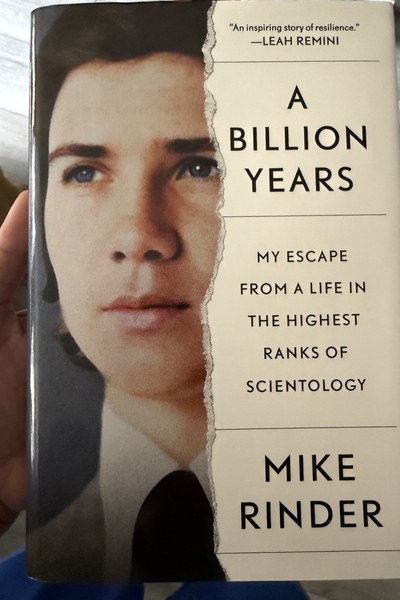
A Billion Years: My Escape from a Life in the Highest Ranks of Scientology
An overview
The book is one of the most important first-hand accounts of how a high-control group operates from the inside. Published in September 2022, the memoir comes fro a man who did not merely belong to the Scientology church, but spent decades defending it in public. Mike Rinder ran the Office of Special Affairs, the church’s legal, intelligence and public relations arm, and for years was its chief spokesman to journalists and governments.
The vantage point is what makes it the book matter. Many ex-member memoirs describe what was done to the author. Rinder describes that too, but he also describes what he did to others, and how he justified it. The result is less a tall-all than a case study in how intelligent, well-meaning people come to defend the indefensible. Rinder, who died of cancer in January 2025, left behind a book that reads as both testimony and confession.
Raised inside the system
Rinder never chose Scientology as an adult. His parents began taking him to their local center in Adelaide, Australia, when he was five. By the time he finished school, the decision had effectively been made for him. Instead of going to university, he signed he Sea Organization’s symbolic billion-year contract, pledging service across countless future lifetimes, and joined L. Ron Hubbard’s fleet of ships.
Here begins an adventure - a revealingly sad - and at times desperate - one for the reader. Rinder worked as a deckhand in grim conditions for almost no pay, yet he described feeling privileged - like most cult followers do. He was close to Hubbard himself, part of an elite with a mission to save the planet. This is the first lesson of the book about cult behaviour: control rarely begins with force. It begins with meaning, belonging and a sense of chosen status - like Godmen in India allot to their followers. Hardship becomes proof of commitment rather than a warning sign like caste system makes people endure unjustifiably and unnecessarily in India.
Rinder rose steadily, eventually becoming one of the most senior figures in the organisation after Hubbard’s death in 1986, working directly under the new leader, David Miscavige.
The Anatomy of Control
The heart of the book is its detailed portrait of the mechanisms Rinder says kept members compliant. Read alongside he wider literature on high-control groups, several patterns stand out.
Total commitment and exhaustion. Sea Org members, as Rinder describes them, worked punishing hours for minimal pay, with little sleep and no meaningful private life. Rinder himself admits his memories of some periods are hazy because he was so tired. Chronic exhaustion leaves little room for doubt or reflection.
Confession and Surveillance. Auditing, Scientology’s core counselling practice encourages members to disclose their most private thoughts and past wrongdoing. Rinder explains how such disclosures could later be used as leverage, turning a spiritual practice into a tool of control.
Punishment and Humiliation. The most disturbing passages concern “the Hole”, a set of office trailers at the church’s international base near Hemet, California. Rinders says senior executives, himself included, were confined there for long periods, made to confess, and pushed into group confrontations. His account echoes that of other former executives.
Disconnection. When Rinder finally left in 2007, aged 52, the cost was his family. His wife and two children stayed and cut contact with him under the church’s policy of disconnection. This is the book’s emotional core: a man who escaped physically but lost nearly everyone he loved. Rinder started to question Miscavige’s behaviour,
‘Is this really Scientology? I wondered. Am I doing what is right and what I signed up for?’
Fair Game. Leaving brought Rinder something else: harassment. He described being followed, filmed and publicly attacked, the same treatment he had once helped direct at critics.
The perpetrator’s confession
What separates this book from most ex-member memoirs is Rinder’s willingness to implicate himself. As Head of Special Affairs, he oversaw the church’s responses to journalists, lawsuits and government inquiries. He acknowledges running operations against critics, denying abuses to reporters he now says were telling the truth, and defending the church through some of its worst public crises.
This honestly is the book’s greatest strength for anyone studying cult behaviour. It shows that high-control groups do not depend only on victims. They depend on loyal insiders - henchmen - who believe the cause is righteous enough to justify almost anything. Rinder describes a mindset in which critics were enemies of humanity, so lying to them or about them felt not just acceptable but ethical.
He is also candid about how slow his awakening was. Even while being abused in the Hole, he did not immediately conclude the organisation was wrong. He blamed himself, assuming he must have failed. That instinct, to turn doubt inward rather than equation the group, is perhaps the most universal insight in the book. It explains why so many people stay in harmful systems long after the evidence should have driven them out.
Strengths and Limits
The writing is direct and unpretentious. Rinder is not a literary stylist, but his plain voice seems pleading throughout. At times it reads like vendetta and he would go to any lengths to end the cult. But that also adds weight to the gravity of danger posed by cult movements to society or impressionable minds - not many dare to question due to peer pressure.
The book is long and emotionally dense for the author. The book is an expression of his feelings and internal state of mind. He has mostly written for his first wife and their two kids. At times it reads a plea to them to get out of the cult, rather then educate the reader about the concrete psychological damage he himself endured. It is a missed opportunity in that aspect. It reads like a revelation - which he rightfully experienced but gradually and not instantly -, and the chronological limits the coherence in the book.
The Church of Scientology has consistently refuted Rinder’s account, disputing his claims about abuse and attacking the credibility. Readers should know that much of what he describes is contested by the organisation and rests on his testimony. But, his descriptions of the Hole, disconnection and Fair Game are corroborated in important respects by other former senior members, journalists and records over several decades. A critical mind can connect the dots from there on.
Verdict
It is essential reading for anyone trying to understand how influence works from high-control groups work. (Personally, I walk out when I am unable to question in a group or any relationship.) Its lessons reach well beyond Scientology. He shows how a group can capture a child before he can consent, reward sacrifice with status, use confession as leverage, punish dissent, and finally make leaving cost everything a person loves.
Above all, it shows that the line between victim and perpetrator inside such groups is often blurred. Rinder was both, and his refusal to hide that makes the book more credible, not less. After leaving, he spent the rest of his life helping others get out, including as co-host of the documentary series Leah Remini: Scientology and the Aftermath.
It is not an easy read at time, and it is one man’s account of a fiercely disputed history. But as a portrait of how belief becomes captivity, and how a person found the courage to walk away, it is hard to beat.