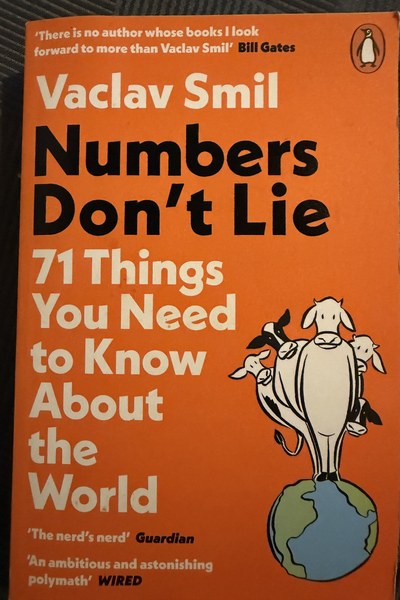
Numbers dont lie
Fews books and people will do a better prognosis on numbers and their interpretations as Simil does in this book. Although, I am disappointed with the proportion of qualitative versus quantitative aspect in the book, but the discussions and their messages are very obvious and direct. 1880s have definitely laid the foundation for the human progress and his accelerated technological growth, and shall forever remain the defining decade for laying its technological foundations.
Many other urban myths of electric vehicles, Moore’s law, etc. come into existence from this book with more numerical proof. This is important because while Moore’s law has driven technology forward but it was again the biased interpretation by magazines and media which incorrectly interpreted it and motivated technology moving forward.
Discussion on human diet, food, pyramid construction, etc. with a quantitative breakdown is a major nuance and defining attribute of the book. Something, that should entice every data centric person to read the book and embrace its core philosophy of breaking down numbers to their bare bones before deriving any sense from them, or cladding them in statistical clothing to induce biased information from the dataset. I relate well with the book because of this approach of the author, as this is my own approach to numbers. I use stats, and algorithms very late in my use with the datasets to derive information.
The book has a positive effect on me but I am unable to pinpoint my exact feelings about it. Its like I love the book but I don’t know why and how? Is it because of tis arcane character, or because it has more numerical truth in it than most garbaged and biased opinions we read? Is it rational and counter intuitive to our own biases? I can categorically say that the book’s writing style is dour but I still read it in two sittings, and forced myself to find time to read in two sittings. So, its not his writing style which makes me love the book.
No idea, but I loved it is all I can say.