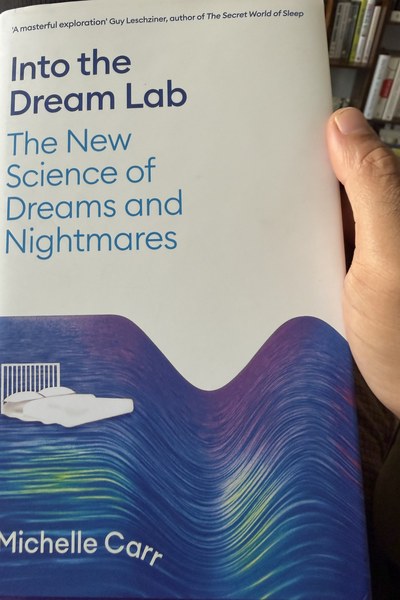
Into the Dream Lab by Michelle Carr
Disappointing to read as a person who is curious about dreams and mental health, for someone who has been researching the same for the past two years. Still interesting enough to learn new techniques that can induce sleep and engineer dreams. These techniques they list what rural communities have practiced for ages - atleast rural communities in India.
One of her suggestions is to maintain a dream journal. I have myself maintained a dream journal for the past fifteen months after a friend’s wife suggested because I was sharing my dream with her in the morning. In these fifteen I have dreamt almost everyday, and remember dreams every third day on average. But, my own dream journal is so contradictory to her finding that we remember our morning dreams in more detail.
I can remember dreams before 0200 also while she suggests that we remember our morning dreams more often and in more detail.. How am I sure about remembering my dreams before 0200? I normally have to pee between 0200 - 0300 hours. When I wake up to pee my head knows what I was dreaming and I can recollect that dream in more details when I wake up in the morning than the ones I dream later on in the sleep.
Highlighting this contradiction is necessary. I can’t refute her data or research from m own single source of data. Its necessary because many health issues are personal and cannot be generalised. Generalisation of these issues is encouraging companies to mass-produce and sell gadgets that makes us more anxious. This aligns with her own criticism of fitness equipment which are not quite accurate in categorising sleep. But, I cannot deny that we can evaluate the overall trend of our health.
I do think she is right that in slowing down time in our waking hours - observe and appreciate the small things probably helps in dreaming. I say this because in my discussions with friends, I am beginning to realise I share the small things - the chat, the smile with the strangers, etc. - but most of them only tell the big events in their life. These insights from her book can help people overcome nightmares and post traumatic stress disorders (PTSD).
Additionally, I found her section on how dreams do give closure on events from real life true. I did find a lot of closure - particularly of dating rejections and some unresolved childhood traumas - in these dreams. Some of these dreams provided the closure metaphorically - atleast Claude and Deepseek interpreted those ways - and others were with the persons themselves.
In the last one year whenever I have faced challenges in my real life - indecisive, stressed, overdoing it -, I would see my dead grandfather smiling at me and guiding me. Next morning, I would wake up more relaxed, and had more clarity in my head. I had a good bond with him, because it is from him I learnt to appreciate the small things in life - responsible gambling, a chat with the neighbour, calmly taking business decisions, flirting at an old age, etc.
Her discussion on lucid dreaming was fascinating. It is presented as a cure for a few mental health disorders like PTSD. Along with dream engineering, it can also be used to overcome nightmares, trauma and is - in my new opinion - a better alternative for overcoming mental health disorders than using drugs. In my review of Prozac Nation, I showed how its author - Elizabeth Wurtel -, had become addicted to it and did not really find drugs so helpful with her condition.
It was new to discover that scents can also help induce better sleep. It probably explains why so many houses have lavender plants. To add to her findings, I found that eating a protein rich/heavy dinner also enables a good sleep and lucid dreaming.
However, I found the book quite superficial. It lacked the scientific depth to explain phenomena or experience, and presented its findings based on 30% and 18% of test subjects. Can her conclusions and ideas be relatable to a wider audience who won’t be in the experimental conditions of her lab? Wait, she herself insinuates that the lab results are more reliable. That is beyond funny, but she appeared on podcasts and was able to convince a friend who suggested this book, and I was stupid enough to have bought it.
If we ignore her academic qualification and read the book overall, the advice presented by her is similar to what rural communities do in order to help their kins. This makes it a very disappointing read for me. Her prose is neither scientific nor story telling. The connectivity between topics and themes doesn’t exist throughout the book. It felt like reading a vignette between good dreams and bad dreams.