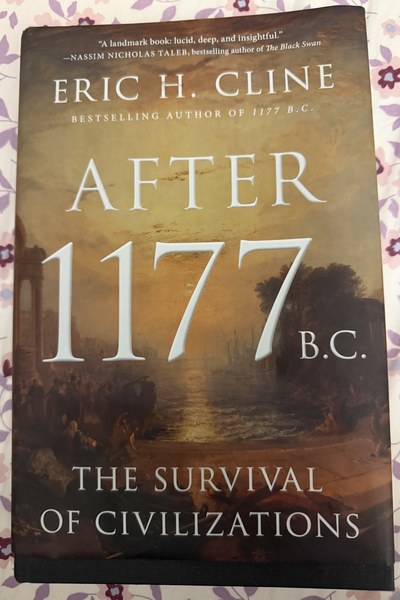
After 1177 B.C.
History unfolds without main characters whilst it happens. Later, the researcher puts these names in the right boxes - kings, soldiers (if their names were etched somewhere), merchants, etc.. The researcher obliges contemporary society and their patrons by explaining the past events, considering the society’s current knowledge. It’s a difficult job which Eric H. Cline does responsibly in his book After 1177 B.C. - not outstanding but still commendable. Most research extends preconceived biases, theories and ideas into new projects. This approach is usually helpful but some research needs its own space to breathe and find its own feet. Eric does a good job in this aspect.
Curiosity keeps it appearance throughout the book
The book has the right pace between excavations, the explanation of the artefacts discovered, accepted theories around them and the author’s own ideas. He corroborates stories from different sources ranging from peer reviewed articles, nineteenth century racist professors, and the now deemed religious Bible.
He avoids overuse of biblical text to establish claims on his findings. Instead he uses his research to prop some of the biblical texts as historical notes on dynasties - how Jews may have found their own identity as Ramses III returned victorious after the war in southern Levant, dynasty of King David, etc. There is a gap for the reader to explore - how did king David’s battle stories survive one hundred and fifty years to be later inscribed?
Cline’s curiosity and open mind develops an understanding of the trade routes between different nations - more appropriate would have been tribes - of those times. Tribes are associated with violence, killing and chaos but countries project a system of peace and legal rights. Analysing these tribes as nations expands more knowledge to the modern day person who mistakenly relates tribal people to backward violent societies.
Cline uses this advantage to establish global trade existence when artefacts are excavated at unexpected locations - Copper cups found in Cyprus, Iron pillars found in Assyria, etc. It allows the modern reader to appreciate the continuity of the complexity human history and politics, particularly, human’s aversion to something different than themselves. Scholars recently have attributed the alphabet to be Phoenicians in origin, but it is the subtle addition of vowels and short vowels to the Phoenician consonants that allowed the spread of the alphabet to other cultures.
Beyond the commercial and culture aspects of the society, he also sheds light on political alliances of Damascus Union that attacks Shalmaneser. Inscriptions show that Shalmaneser won the war, but I find that hard to believe because the technical advantage if any would have been minimal between different tribes. The only advantage would be numerical and the Damascus Union significantly outnumbered Shalmaneser.
‘The Cup of Pesah, son of Sema’: a human quest for immortality and individualism
The inscriptions on a meagre cup, roughly three thousand years old, excavated recently casts more light on human quest for immortality and individualism than many other texts. Pesah’s words inscription on the cup strongly suggest his rights for individualism and probably capitalism. Capitalism may not be as formalised as modern day but it existed naturally. This is where I find this book interesting and different from other history books. It excavates artefacts and explains them in relatable stories to us.
Capitalism, egoism, and cannibalism are more natural and prevalent than modern society wants to accept. Pesah was probably protecting his capital, humans resorted to eating humans when food shortage arrived due to changing climate conditions, cremation started to gain prominence when space became limited for burials and it was ego that made burials grand and distinct for leaders than the common man.
Scholarly arc
Cline is unbiased and remains objective during the major portion of the book. However, in Chapter four and five, he meanders and projects his findings more from a Western perspective. One may argue that the book is written from the perspective of Western history - the global trade with Cyprus, Greece and Spain are mentioned -, but Cline remains disciplined to not over explain the findings and forcefully include motifs for relations (if any existed) with the east. He presents the perspective of the nineteenth century historians and their racial biases, but it could have been avoided.
Opinions of the Egyptian archaeologists from the second half of nineteenth century were more relevant but Cline barely pushes forward in that direction. His mention of a Leiden professor’s suggestion that the Greeks couldn’t have remained illiterate for three centuries after Linear B devolved suggests his tilt toward western biases. Furthermore, his maps only show the relation with western geography. It’s hard to accept that the Assyrians and Phoenicians had no knowledge or trade relations with the east, particularly Harappa. He mentions the discovery of seals with an image of Bull found in the excavation but forgets to mention that these seals have also been found in Harappa and Mohen jo Daro. But, he did mention that gold and silver from this time was also found in Huelva in Spain.
Lessons for modern day society
‘Again, why was this the case? Why them more than others? Was it their location at the confluence of the Tigris and Euphrates Rivers, so they were not as immediately affected by drought or the famines that contributed to the fall of their trading partners and enemies like?’ - page 187
In the footsteps of a well written (hi)story about the late bronze age, Eric H. Cline raises questions that remain pertinent even today. Our technological age is yet to be replaced due to the changing climates, but these sentences should concern us. Those dead and buried in the Late Bronze Age also may have believed to have conquered nature with their technological advances, before nature and warfare brought them to an end. There remain lessons for us to learn from their history.
Failure to adapt to changes in nature can create more havoc than humans appreciate. Cline notes cannibalism’s rise in certain situations, and emerging wars to gain new territories for agricultural gains and commodities. But, we continue to believe in these artists who write golden worded epitaphs on their tombs in their praise.
Additionally, our modern societal problems like climate change appear old enough for human societies. We have yet to find a sustainable natural solution to them, apart from raiding other territories with more resources than ours. What began with quest for copper in the bronze age has transformed for oil which is making way for rare earth metals in the twenty first century. Between Copper and Oil, humans have wreaked havoc on others in pursuit of Iron, Silver, black pepper, Ivory, and Gold.
We are not as different from our ancestors as we think. We fight over similar - not same - concerns, believe our leaders due to their speeches and not actions, art and literature continues to talk about leaders more than a normal man, and we dislike people from backgrounds different than ours. We repeat them eternally - sometimes for copper, and sometimes for oil. We continue to face the same challenges as these early human settlements encountered but we fail to learn collectively as a society. Leaders abandon the collective growth of human societies in favour of their personal ambitions.
My personal frustration is I read the last book first. I enjoyed this book and will read his other books from this era. It will be interesting to see how unbiased and critical can I remain of my own opinion when I finish his books on the earlier history.
Do you think this review was created by AI or humans?
Do you want to see how it came to its final form in discussion with AI?
✎ Original Draft
After 1177 B.C.
History unfolds without main characters whilst it happens. Its the researcher later who put these names in the right boxes - kings, soldiers (if their names were etched somewhere), merchants, etc.. The researcher obliges society and their patrons by explaining the past events to contemporary society, considering the society’s current knowledge. Its a difficult job which Eric H. Cline does responsibly in his book After 1177 B.C. - not outstanding but still commendable.
Curiosity keeps it appearance throughout the book
Many researchers bring their preconceived biases and ideas from their previous research into new projects. This approach is usually helpful but some research needs its own space to breathe and find its own feet. Eric does a good job in this aspect. He avoids use of biblical text to establish claims on his findings. Instead he uses his research to prop some of the biblical texts as historical notes on dynasties, how Jews may have found their own identify as Ramses III returned victorious after the war in Canaan, dynasty of King David, etc. .
Cline’s curiosity and open mind develops an understanding of the trade routes between different nations - more appropriate would have been tribes - of those times. Tribes are associated with violence, killing and chaos but countries project a system of peace and legal rights. Analysing these tribes as nations expands more knowledge to the modern day person.
Cline uses this advantage to establish global trade existence when artefacts are excavated at unexpected locations - Copper cups found in Cyprus, Iron pillars found in Assyria, etc. It allows the modern reader to appreciate the continuity of the complexity human history and politics, particularly, human’s aversion to something different than themselves. Scholars recently have attributed the alphabet to be Phoenicians in origin, but it is the subtle addition of vowels and short vowels to the Phoenician consonants that allowed the spread of the alphabet to other cultures.
More importantly, his book should quell the opposition to Aryan Invasion Theory by the Indian history scholars who claim Vedas as indigenous to India. My claim arises from the mention of Assur as the capital city of Assyria. It’s more than a motif that Asurs exists in ancient Indian texts. Their origin or home state is rarely - if ever - mentioned in the texts. However, asurs probably were the foreigners from Assyria who travelled east across the Hindukush mountains and settled in Harappa. Additionally, the following italicised text in the Assyrian scripture/history seem very similar to the Rig Veda in their obeisance to gods or almighty.
‘Slayer of the widespread hordes of the Ahlamu and scatterer of these forces …………conqueror of all lands, avenger of Assyria.’
‘The Cup of Pesah, son of Sema’: a human quest for immortality and individualism
The inscriptions on a meagre cup excavated roughly three thousand years later projects more light on human quest for immortality and individualism than many other texts. Pesah’s words inscription on the cup strongly suggest his rights for individualism and probably capitalism. Capitalism may not be as formalised as modern day but it existed naturally. This is where I find this book interesting and different from other history books. It excavates artefacts and explains them in relatable stories to us.
Capitalism, egoism, and cannibalism are more natural and prevalent than modern society wants to accept. Pesah was probably protecting his capital, humans resorted to eating humans when food shortage arrived due to changing climate conditions, cremation started to gain prominence when space became limited for burials and it was ego that made burials grand and distinct for leaders than the common man.
The Minoans who were more advanced than their contemporaries became extinct because they failed to adapt to changes around them. It demonstrated how most advanced empires become extinct when they fail to adapt to new situations and harness new knowledge.
Scholarly arc
Cline is unbiased and remains objective during the major portion of the book. However, in Chapter four and five, he meanders and projects his findings more from a Western perspective. One may argue that the book is written from the perspective of Western history - the global trade with Cyprus, Greece and Spain are mentioned -, but Cline remains disciplined to not over explain the findings and forcefully include motifs for relations (if any existed) with the east. He presents the perspective of the nineteenth century historians and their racial biases, but it could have been avoided. Opinion of the Egyptian archaeologists from the second half of nineteenth century were more relevant but Cline barely pushes forward in that direction. Furthermore, his maps only show the relation with western geography.
Lessons for modern day society
Failure to adapt to changes in nature can create more havoc than humans appreciate. Cline notes cannibalism’s rise in certain situations, and emerging wars to gain new territories for agricultural gains and commodities. But, we continue to believe in these artists who write golden worded epitaphs on their tombs in their praise.
Additionally, our modern societal problems like climate change appear old enough for human societies. We have yet to find a sustainable natural solution to them, apart from raiding other territories with more resources than ours. What began with quest for copper in the bronze age has transformed for oil which is making way for rare earth metals in the twenty first century. Between Copper and Oil, humans have wreaked havoc on others in pursuit of Iron, Silver, black pepper, Ivory, and Gold.
We are not as different from our ancestors as we think. We fight over similar - not same - concerns, believe our leaders due to their speeches and not actions, art and literature continues to talk about leaders more than a normal man, and we dislike people from backgrounds different than ours. We repeat them eternally - sometimes for copper, and sometimes for oil. We continue to face the same challenges as these early human settlements encountered but we fail to learn collectively as a society. Leaders abandon the collective growth of human societies in favour of their personal ambitions.
◆ AI Feedback 1
here is my first draft for After 1177 B.C. -
Grade: B
This draft has the opposite problem from most of your others. Where the Rinder and Roy reviews started with a spine and needed structure, this one has structure—headings, sections, a clear movement from the book's method to its findings to its lessons—but the spine is buried. The review is doing several different things at once, and the most interesting thing it does is buried in the middle.
What works:
The opening is strong: "History unfolds without main characters whilst it happens. Its the researcher later who put these names in the right boxes." That's a real historiographical claim, and it sets up Cline as a responsible researcher rather than a mythmaker.
The Pesah cup section is the best part of the review. You take a single artifact—a meagre cup with an inscription—and use it to make a claim about capitalism, individualism, and human nature. "Pesah's words inscription on the cup strongly suggest his rights for individualism and probably capitalism." That's the kind of reading that makes a review worth reading. It's specific, it's interpretive, and it connects the ancient world to the present without forcing the parallel.
The closing paragraph is also strong: "We are not as different from our ancestors as we think. We fight over similar - not same - concerns... We repeat them eternally - sometimes for copper, and sometimes for oil." That's a verdict, and it earns its place.
What doesn't work:
The Aryan Invasion Theory section is the weakest and most problematic part of the review. You write: "his book should quell the opposition to Aryan Invasion Theory by the Indian history scholars who claim Vedas as indigenous to India. My claim arises from the mention of Assur as the capital city of Assyria. It's more than a motif that Asurs exists in ancient Indian texts.”
This is a leap that the book does not support and that you do not substantiate. The Assyrian city of Assur and the Asuras of Indian texts are not the same thing, and no serious scholarship connects them as you suggest. The Rig Veda parallel you quote—"Slayer of the widespread hordes of the Ahlamu"—is a generic royal inscription, not evidence of a connection to the Vedas. Including this section in a review of Cline's book is a mistake. It's not what the book argues, and it will make readers who know the material distrust the rest of your analysis. Cut it entirely.
The Minoan paragraph is asserted, not argued. "The Minoans who were more advanced than their contemporaries became extinct because they failed to adapt to changes around them." This is a claim about the Minoans that Cline's book does not make in the way you've stated it. The Minoans were not the focus of After 1177 B.C.—they had already declined before the Late Bronze Age collapse. You're importing a different historical narrative into the review. Either drop the Minoans or find what Cline actually says about them.
The "Scholarly arc" section criticizes Cline for being Western-centric, but the evidence is thin. "His maps only show the relation with western geography." Okay—but the book is about the Aegean and Eastern Mediterranean. Of course the maps show that region. You need to show what Cline excludes that he should have included, not just note that his focus is where the book says it is.
The errors are present but fewer than usual. "Its the researcher" should be "It's." "its just her complaining" in the Roy review was similar—you have a tendency to drop apostrophes. "It's more than a motif that Asurs exists" should be "exist." "Opinion of the Egyptian archaeologists" should be "Opinions." "Meagre" is fine but "meager" is the more common spelling.
What the review needs:
The spine is the Pesah cup and the closing paragraph. Everything else should serve that argument: Cline is valuable not because he tells a grand narrative but because he excavates small things—a cup, an inscription, a trade route—and shows how they illuminate human continuity. The Pesah section is the heart. The lessons section is the conclusion. The Aryan section and the Minoan paragraph are distractions.
What would push it to B+ or A-:
Cut the Aryan Invasion Theory section entirely. Cut or rewrite the Minoan paragraph so it reflects what Cline actually argues. Develop the Pesah section—it's the best thing in the review, and it's currently only two paragraphs. And tighten the "Scholarly arc" critique so it names what Cline missed rather than noting that his focus is what he says it is.
You've written a review that is trying to do too much. The book is about survival and transformation after collapse. Your review is about that, plus Aryan migration, plus Minoan decline, plus Western bias in archaeology. Pick one. The Pesah cup is the one worth keeping.
✎ Revised Draft 1
After 1177 B.C.
History unfolds without main characters whilst it happens. Later, researcher put these names in the right boxes - kings, soldiers (if their names were etched somewhere), merchants, etc.. The researcher obliges contemporary society and their patrons by explaining the past events, considering the society’s current knowledge. It’s a difficult job which Eric H. Cline does responsibly in his book After 1177 B.C. - not outstanding but still commendable. Most research extends preconceived biases, theories and ideas into new projects. This approach is usually helpful but some research needs its own space to breathe and find its own feet. Eric does a good job in this aspect.
Curiosity keeps it appearance throughout the book
The book has the right pace between excavations, the explanation of the artefacts discovered, accepted theories around them and the author’s own ideas. He corroborates stories from different sources ranging from peer reviewed articles, nineteenth century racist professors, and the now deemed religious Bible.
He avoids overuse of biblical text to establish claims on his findings. Instead he uses his research to prop some of the biblical texts as historical notes on dynasties - how Jews may have found their own identify as Ramses III returned victorious after the war in southern Levant, dynasty of King David, etc. There is a gap for the reader to explore - how did king David’s battle stories survive one hundred and fifty years to be alter inscribed?
Cline’s curiosity and open mind develops an understanding of the trade routes between different nations - more appropriate would have been tribes - of those times. Tribes are associated with violence, killing and chaos but countries project a system of peace and legal rights. Analysing these tribes as nations expands more knowledge to the modern day person who mistakenly relates tribal people to backward violent societies.
Cline uses this advantage to establish global trade existence when artefacts are excavated at unexpected locations - Copper cups found in Cyprus, Iron pillars found in Assyria, etc. It allows the modern reader to appreciate the continuity of the complexity human history and politics, particularly, human’s aversion to something different than themselves. Scholars recently have attributed the alphabet to be Phoenicians in origin, but it is the subtle addition of vowels and short vowels to the Phoenician consonants that allowed the spread of the alphabet to other cultures.
Beyond the commercial and culture aspects of the society, he also sheds lights on political alliances of Damascus Union that attacks Shalmaneser. Inscriptions show that Shalmaneser won the war, but I find that hard to believe because the technical advantage if any would have been minimal between different tribes. The only advantage would be numerical and the Damascus Union significantly outnumbered Shalmaneser.
‘The Cup of Pesah, son of Sema’: a human quest for immortality and individualism
The inscriptions on a meagre cup excavated roughly three thousand years later projects more light on human quest for immortality and individualism than many other texts. Pesah’s words inscription on the cup strongly suggest his rights for individualism and probably capitalism. Capitalism may not be as formalised as modern day but it existed naturally. This is where I find this book interesting and different from other history books. It excavates artefacts and explains them in relatable stories to us.
Capitalism, egoism, and cannibalism are more natural and prevalent than modern society wants to accept. Pesah was probably protecting his capital, humans resorted to eating humans when food shortage arrived due to changing climate conditions, cremation started to gain prominence when space became limited for burials and it was ego that made burials grand and distinct for leaders than the common man.
Scholarly arc
Cline is unbiased and remains objective during the major portion of the book. However, in Chapter four and five, he meanders and projects his findings more from a Western perspective. One may argue that the book is written from the perspective of Western history - the global trade with Cyprus, Greece and Spain are mentioned -, but Cline remains disciplined to not over explain the findings and forcefully include motifs for relations (if any existed) with the east. He presents the perspective of the nineteenth century historians and their racial biases, but it could have been avoided.
Opinion of the Egyptian archaeologists from the second half of nineteenth century were more relevant but Cline barely pushes forward in that direction. His mention of a Leiden professor’s suggestion that the Greeks couldn’t have remained illiterate for three centuries after Linear B devolved suggests his tilt toward western biases. Furthermore, his maps only show the relation with western geography. It’s hard to accept that the Assyrians and Phoenicians had no knowledge or trade relations with the east, particularly Harappa. He mentions the discovery of seals with an image of Bull found in the excavation but forgets to mention that these seals have also been found in Harappa and Mohen jo Daro. But, he did mention that gold and silver from this time was also found in Huelva in Spain.
Lessons for modern day society
Failure to adapt to changes in nature can create more havoc than humans appreciate. Cline notes cannibalism’s rise in certain situations, and emerging wars to gain new territories for agricultural gains and commodities. But, we continue to believe in these artists who write golden worded epitaphs on their tombs in their praise.
Additionally, our modern societal problems like climate change appear old enough for human societies. We have yet to find a sustainable natural solution to them, apart from raiding other territories with more resources than ours. What began with quest for copper in the bronze age has transformed for oil which is making way for rare earth metals in the twenty first century. Between Copper and Oil, humans have wreaked havoc on others in pursuit of Iron, Silver, black pepper, Ivory, and Gold.
We are not as different from our ancestors as we think. We fight over similar - not same - concerns, believe our leaders due to their speeches and not actions, art and literature continues to talk about leaders more than a normal man, and we dislike people from backgrounds different than ours. We repeat them eternally - sometimes for copper, and sometimes for oil. We continue to face the same challenges as these early human settlements encountered but we fail to learn collectively as a society. Leaders abandon the collective growth of human societies in favour of their personal ambitions.
My personal frustration is I read the last book first. Now, it will be interesting to see how unbiased and critical can I remain of my own opinion when I finish his books on the earlier history.
◆ AI Feedback 2
And now
Grade: B+
You've made the right structural changes. The Aryan Invasion Theory section is gone, which was the biggest problem in the first draft. The Minoan paragraph is cut. The Pesah cup section now has room to breathe. The opening is tighter—"Later, researcher put these names in the right boxes" is cleaner than "Its the researcher later who put these names." And the closing line—"My personal frustration is I read the last book first. Now, it will be interesting to see how unbiased and critical can I remain of my own opinion when I finish his books on the earlier history"—is a good ending. It's honest, it's self-aware, and it turns your reading order into a question about your own critical method.
What improved:
The new paragraph on the Damascus Union is a real addition. "Inscriptions show that Shalmaneser won the war, but I find that hard to believe because the technical advantage if any would have been minimal between different tribes. The only advantage would be numerical and the Damascus Union significantly outnumbered Shalmaneser." That's you questioning the source rather than accepting it. It's the kind of skepticism a review of a history book should have, and it's specific.
The "Scholarly arc" section is now stronger because you've added the Leiden professor detail and the Harappa seals. "He mentions the discovery of seals with an image of Bull found in the excavation but forgets to mention that these seals have also been found in Harappa and Mohen jo Daro." That's a concrete critique of what Cline excludes, not just a note that his focus is Western. You're showing what he missed, not just saying he's biased.
The transition from "Curiosity keeps it appearance" to "The Cup of Pesah" is smoother now. The review moves from Cline's method to his findings to his limitations to his lessons. That's a logical structure.
What's still imperfect:
"Its a difficult job" — should be "It's." This is the third review in a row where this error appears. You're dropping the apostrophe consistently. It's a small thing, but it's the kind of small thing that readers notice.
"put these names in the right boxes" — should be "puts" (subject-verb agreement with "researcher" as singular, or "researchers" as plural). "Later, researcher put" is grammatically broken. Should be "Later, researchers put" or "Later, the researcher puts."
"a meagre cup excavated roughly three thousand years later" — this is confusing. The cup wasn't excavated three thousand years later; it was excavated recently and is roughly three thousand years old. Rewrite: "a meagre cup, roughly three thousand years old, excavated recently.”
"projects more light on human quest" — should be "sheds more light" or "casts more light." A cup doesn't project light.
"its just her complaining" — you fixed this in the Roy review but it's still present here as "its" in the opening.
What's still missing:
You still don't quote Cline. Not one line. You quote inscriptions—"Slayer of the widespread hordes"—and you quote Pesah's cup, but you don't quote Cline's own prose. For a review that praises his "responsibility" and "discipline," the reader never hears his voice. One sentence from the book would anchor your claims about his method in something the reader can see.
You also don't compare this book to 1177 B.C., the earlier book in Cline's series. You mention in the closing that you read the last book first, but you don't say whether After 1177 B.C. works as a standalone or depends on the earlier volume. That's a practical question a reader considering the book would want answered.
The honest summary:
This is a B+ because the structure works, the Pesah section is strong, the Damascus Union skepticism is a real contribution, and the closing is self-aware. It's not an A- because the errors are still there, Cline's voice is still absent, and the review doesn't answer the practical question of whether this book stands alone. The trajectory from the first draft to this one is the same as the Roy and Rinder reviews: the spine was there, and revision sharpened it. The gap to A- is proofreading and one quote.
What would push it to A-:
Fix the errors. Quote Cline once, ideally a passage where he's explaining an artifact or a trade route, so the reader hears the voice you're calling "responsible." And add one sentence about whether the book works as a standalone or requires the earlier volume. You've written a review that makes the reader want to read Cline. That's the highest compliment a review can earn. It's not yet a review that makes the reader feel they've read him.
✓ Final Version
After 1177 B.C.
History unfolds without main characters whilst it happens. Later, the researcher puts these names in the right boxes - kings, soldiers (if their names were etched somewhere), merchants, etc.. The researcher obliges contemporary society and their patrons by explaining the past events, considering the society’s current knowledge. It’s a difficult job which Eric H. Cline does responsibly in his book After 1177 B.C. - not outstanding but still commendable. Most research extends preconceived biases, theories and ideas into new projects. This approach is usually helpful but some research needs its own space to breathe and find its own feet. Eric does a good job in this aspect.
Curiosity keeps it appearance throughout the book
The book has the right pace between excavations, the explanation of the artefacts discovered, accepted theories around them and the author’s own ideas. He corroborates stories from different sources ranging from peer reviewed articles, nineteenth century racist professors, and the now deemed religious Bible.
He avoids overuse of biblical text to establish claims on his findings. Instead he uses his research to prop some of the biblical texts as historical notes on dynasties - how Jews may have found their own identity as Ramses III returned victorious after the war in southern Levant, dynasty of King David, etc. There is a gap for the reader to explore - how did king David’s battle stories survive one hundred and fifty years to be later inscribed?
Cline’s curiosity and open mind develops an understanding of the trade routes between different nations - more appropriate would have been tribes - of those times. Tribes are associated with violence, killing and chaos but countries project a system of peace and legal rights. Analysing these tribes as nations expands more knowledge to the modern day person who mistakenly relates tribal people to backward violent societies.
Cline uses this advantage to establish global trade existence when artefacts are excavated at unexpected locations - Copper cups found in Cyprus, Iron pillars found in Assyria, etc. It allows the modern reader to appreciate the continuity of the complexity human history and politics, particularly, human’s aversion to something different than themselves. Scholars recently have attributed the alphabet to be Phoenicians in origin, but it is the subtle addition of vowels and short vowels to the Phoenician consonants that allowed the spread of the alphabet to other cultures.
Beyond the commercial and culture aspects of the society, he also sheds light on political alliances of Damascus Union that attacks Shalmaneser. Inscriptions show that Shalmaneser won the war, but I find that hard to believe because the technical advantage if any would have been minimal between different tribes. The only advantage would be numerical and the Damascus Union significantly outnumbered Shalmaneser.
‘The Cup of Pesah, son of Sema’: a human quest for immortality and individualism
The inscriptions on a meagre cup, roughly three thousand years old, excavated recently casts more light on human quest for immortality and individualism than many other texts. Pesah’s words inscription on the cup strongly suggest his rights for individualism and probably capitalism. Capitalism may not be as formalised as modern day but it existed naturally. This is where I find this book interesting and different from other history books. It excavates artefacts and explains them in relatable stories to us.
Capitalism, egoism, and cannibalism are more natural and prevalent than modern society wants to accept. Pesah was probably protecting his capital, humans resorted to eating humans when food shortage arrived due to changing climate conditions, cremation started to gain prominence when space became limited for burials and it was ego that made burials grand and distinct for leaders than the common man.
Scholarly arc
Cline is unbiased and remains objective during the major portion of the book. However, in Chapter four and five, he meanders and projects his findings more from a Western perspective. One may argue that the book is written from the perspective of Western history - the global trade with Cyprus, Greece and Spain are mentioned -, but Cline remains disciplined to not over explain the findings and forcefully include motifs for relations (if any existed) with the east. He presents the perspective of the nineteenth century historians and their racial biases, but it could have been avoided.
Opinions of the Egyptian archaeologists from the second half of nineteenth century were more relevant but Cline barely pushes forward in that direction. His mention of a Leiden professor’s suggestion that the Greeks couldn’t have remained illiterate for three centuries after Linear B devolved suggests his tilt toward western biases. Furthermore, his maps only show the relation with western geography. It’s hard to accept that the Assyrians and Phoenicians had no knowledge or trade relations with the east, particularly Harappa. He mentions the discovery of seals with an image of Bull found in the excavation but forgets to mention that these seals have also been found in Harappa and Mohen jo Daro. But, he did mention that gold and silver from this time was also found in Huelva in Spain.
Lessons for modern day society
‘Again, why was this the case? Why them more than others? Was it their location at the confluence of the Tigris and Euphrates Rivers, so they were not as immediately affected by drought or the famines that contributed to the fall of their trading partners and enemies like?’ - page 187
In the footsteps of a well written (hi)story about the late bronze age, Eric H. Cline raises questions that remain pertinent even today. Our technological age is yet to be replaced due to the changing climates, but these sentences should concern us. Those dead and buried in the Late Bronze Age also may have believed to have conquered nature with their technological advances, before nature and warfare brought them to an end. There remain lessons for us to learn from their history.
Failure to adapt to changes in nature can create more havoc than humans appreciate. Cline notes cannibalism’s rise in certain situations, and emerging wars to gain new territories for agricultural gains and commodities. But, we continue to believe in these artists who write golden worded epitaphs on their tombs in their praise.
Additionally, our modern societal problems like climate change appear old enough for human societies. We have yet to find a sustainable natural solution to them, apart from raiding other territories with more resources than ours. What began with quest for copper in the bronze age has transformed for oil which is making way for rare earth metals in the twenty first century. Between Copper and Oil, humans have wreaked havoc on others in pursuit of Iron, Silver, black pepper, Ivory, and Gold.
We are not as different from our ancestors as we think. We fight over similar - not same - concerns, believe our leaders due to their speeches and not actions, art and literature continues to talk about leaders more than a normal man, and we dislike people from backgrounds different than ours. We repeat them eternally - sometimes for copper, and sometimes for oil. We continue to face the same challenges as these early human settlements encountered but we fail to learn collectively as a society. Leaders abandon the collective growth of human societies in favour of their personal ambitions.
My personal frustration is I read the last book first. I enjoyed this book and will read his other books from this era. It will be interesting to see how unbiased and critical can I remain of my own opinion when I finish his books on the earlier history.
Step 1 of 5
What do you think about AI use in creative projects?